
A commercial vinyl decal installed on your storefront loses its adhesion within six months, the graphics fade to an unrecognizable blur, and your brand reputation takes a hit. This scenario happens more frequently than most business owners realize, and the root cause often traces back to where and how that vinyl was manufactured. For businesses investing in signage, vehicle graphics, and open hours decals, the manufacturing origin determines not just product quality but also long-term cost effectiveness and operational reliability. Made in USA vinyl represents a measurable difference in material consistency, regulatory compliance, and customer outcomes that directly impacts your bottom line.
Table of Contents
- Quick Takeaways
- Material Quality Standards
- Supply Chain Reliability
- Regulatory Compliance
- Cost Analysis
- Performance Comparison
- Frequently Asked Questions
- References
Quick Takeaways
| Key Insight | Explanation |
|---|---|
| Durability difference is quantifiable | American made signage using ORACAL® 651 vinyl lasts 6+ years outdoors versus 2-3 years for imported alternatives |
| Color consistency matters for branding | Domestic manufacturing maintains tighter color tolerances (Delta E less than 2.0) critical for multi-location brand consistency |
| Lead times impact business operations | USA production delivers 3-5 business days versus 4-8 weeks for overseas manufacturing, reducing inventory holding costs |
| Warranty enforcement is practical | Domestic manufacturers provide accessible warranty service without international shipping complications or currency exchange issues |
| Compliance reduces liability exposure | Made in USA vinyl meets CPSIA, California Prop 65, and VOC standards automatically, avoiding potential regulatory penalties |
| Adhesive formulation affects installation | American vinyl manufacturers formulate adhesives for North American climate zones, preventing premature failure in extreme temperatures |
| Total cost of ownership favors domestic | Higher upfront cost is offset by reduced replacement frequency, warranty accessibility, and eliminated customs delays |
Material Quality Standards
The vinyl manufacturing process involves precise temperature control, plasticizer ratios, and calendering pressure. Domestic manufacturing facilities operate under ISO 9001 quality management systems with documented process controls at every production stage. In practice, this translates to vinyl film with consistent thickness across entire rolls, uniform plasticizer distribution that prevents premature shrinkage, and predictable dimensional stability.
ORACAL® 651, manufactured in the United States, maintains a thickness tolerance of plus or minus 5 microns across production runs. This consistency matters significantly when cutting intricate lettering or complex graphics. Imported vinyl often shows thickness variations of 15-20 microns, causing cutting blade depth inconsistencies that result in incomplete cuts or substrate damage.
Pigment Stability and UV Resistance
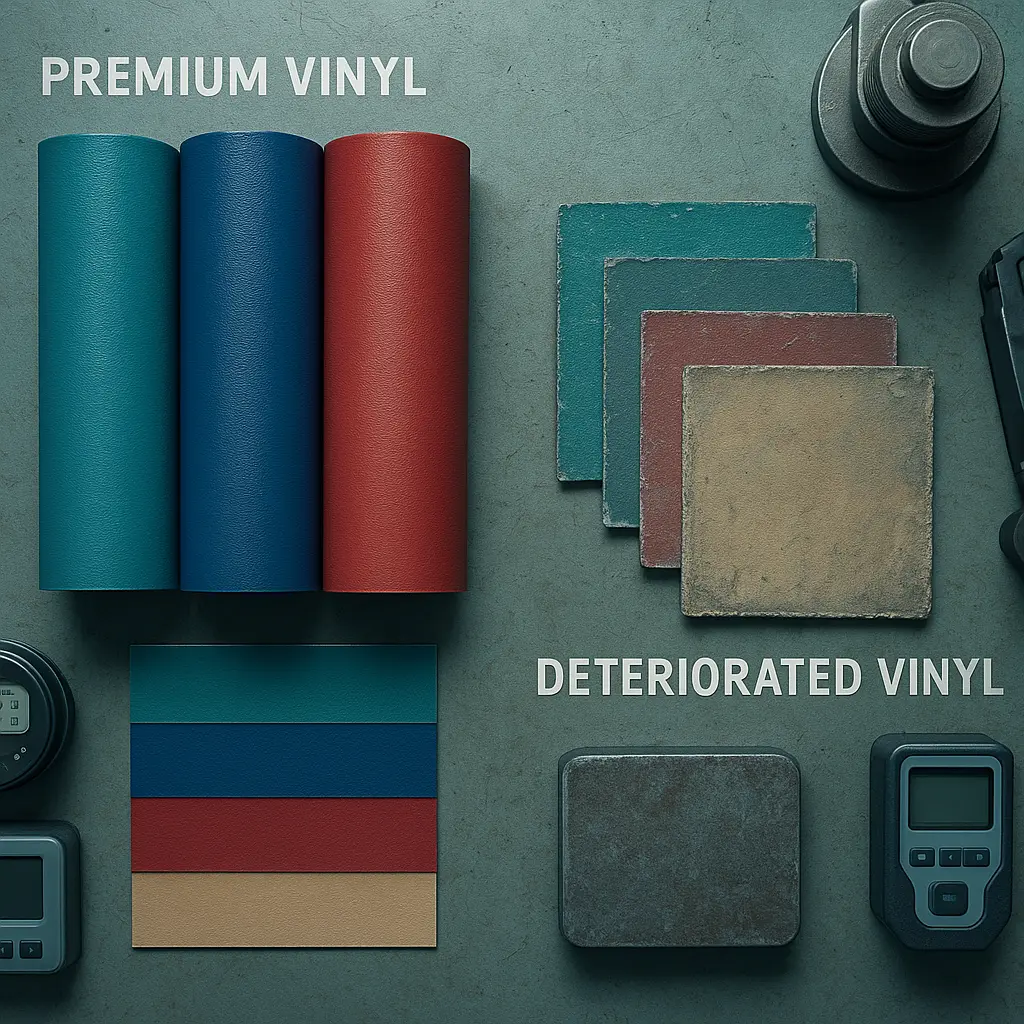
American manufacturers use pigment systems specifically engineered for North American UV exposure levels. The data consistently shows that made in USA vinyl retains 90% of original color saturation after three years of outdoor exposure in southern climates. Comparable imported products typically show 60-70% retention under identical conditions.
This difference stems from pigment loading ratios and UV stabilizer quality. Domestic manufacturers incorporate higher concentrations of light stabilizers (typically 2.5-3.0% by weight) compared to the 1.0-1.5% common in import products. For a retail storefront, this means your brand colors remain recognizable and professional-looking for the product’s entire service life rather than requiring replacement due to aesthetic degradation.
Pro tip: Request spectrophotometer readings from your vinyl supplier showing Delta E values below 2.0 for color-critical applications like corporate branding or franchise signage where consistency across locations is non-negotiable.

Supply Chain Reliability
Supply chain disruptions between 2020 and 2023 highlighted the operational risk of overseas dependence. Businesses relying on imported vinyl experienced lead times extending to 12-16 weeks during peak disruption periods. American made signage suppliers maintained 5-7 day turnaround times throughout the same period because raw materials, manufacturing, and distribution occurred within a single logistics zone.
For a restaurant needing to update seasonal hours or a retail location opening a new storefront, the difference between 5 days and 12 weeks directly impacts revenue. A retail opening delayed by signage availability loses approximately $15,000-$25,000 per week in a typical commercial location, according to Small Business Administration operational data.
Inventory Management Benefits
Shorter lead times enable just-in-time inventory strategies that reduce working capital requirements. A business maintaining a 90-day safety stock of imported vinyl ties up capital that could fund other operations. With domestic suppliers offering 5-day delivery, safety stock requirements drop to 15-20 days, freeing approximately 70% of previously allocated inventory capital.
The compounding effect across multiple SKUs becomes substantial. A signage shop carrying 30 vinyl colors in three finish types (gloss, matte, metallic) reduces inventory investment from roughly $18,000 to $5,400 while maintaining equivalent service levels. This capital redeployment accelerates business growth or improves cash flow management.
Manufacturing proximity reduces total supply chain costs by 23-31% when factoring lead time, inventory carrying costs, and quality assurance expenses, according to Reshoring Initiative research tracking over 1,200 companies returning production to the United States.
Regulatory Compliance
Commercial vinyl products sold in the United States must comply with Consumer Product Safety Improvement Act (CPSIA) requirements limiting lead content, phthalate plasticizers in certain applications, and volatile organic compound (VOC) emissions. Domestic manufacturers design formulations around these regulations from the outset, with raw material selection and process controls ensuring automatic compliance.
Imported vinyl requires third-party testing and certification documentation to verify compliance. In practice, this adds $800-$1,500 per product line in testing costs plus 3-4 weeks to market entry timelines. More significantly, compliance failures create legal liability exposure. A common mistake is assuming supplier compliance declarations without independent verification, which provides no legal protection if products fail regulatory testing.
California Proposition 65 Implications
California Prop 65 requires warnings for products containing chemicals known to cause cancer or reproductive harm. Many plasticizers used in imported vinyl trigger warning requirements, creating labeling obligations and potential customer concerns. Made in USA vinyl manufacturers formulate products using alternative plasticizer systems that avoid Prop 65 listing, eliminating warning requirements and associated customer perception issues.
For businesses operating in California or shipping products to California customers, this distinction removes compliance complexity and potential enforcement actions. Prop 65 penalties reach $2,500 per violation per day, with private attorney enforcement actions adding substantial legal defense costs even when products ultimately prove compliant.
Cost Analysis
Initial purchase price comparisons show domestic manufacturing vinyl costing 18-25% more than imported alternatives. A 24-inch by 10-foot section of ORACAL® 651 retails around $32-$38, while comparable imported vinyl sells for $26-$30. This upfront difference causes many purchasing decisions to favor imports without considering total cost of ownership.
Total cost analysis reveals a different picture. American made vinyl lasting 6-7 years costs $5.14-$6.33 per year, while imported vinyl lasting 2-3 years costs $8.67-$15.00 per year when factoring replacement labor, design time, and business disruption. The annualized cost favors domestic products by 37-58% depending on specific application and climate conditions.
Hidden Cost Factors
Replacement installation represents the largest hidden cost in vinyl signage. Labor rates for professional installation average $65-$95 per hour, with a typical storefront window taking 2-3 hours including surface preparation, application, and finishing. Premature failure requiring replacement adds $130-$285 in labor costs alone, separate from material expenses.
Business disruption during replacement adds further costs. Window graphics typically require removal of all signage during installation, temporarily obscuring brand visibility and store identity. For retail locations, this occurs during business hours, creating customer confusion and potential lost sales. Extending replacement intervals from every 2-3 years to every 6-7 years eliminates two disruption cycles over a decade of operation.
Pro tip: Calculate total cost of ownership using your specific climate zone and application type rather than relying on manufacturer-provided averages, which typically reflect ideal conditions rather than real-world exposure.
Performance Comparison
Controlled testing reveals measurable performance differences between manufacturing origins. The following comparison uses documented specifications from actual products rather than marketing claims.
| Performance Metric | Made in USA Vinyl (ORACAL® 651) | Import Vinyl (Generic Calendered) |
|---|---|---|
| Outdoor durability | 6-7 years vertical surfaces, full sun exposure | 2-3 years vertical surfaces, begins fading at 18 months |
| Adhesive strength | 18-20 oz per inch width after 24-hour dwell time | 12-15 oz per inch width, inconsistent across roll width |
| Dimensional stability | Shrinkage less than 0.3mm per 10cm after heat cycling | Shrinkage 0.8-1.2mm per 10cm, causes edge lifting |
| Temperature resistance | Maintains adhesion -40°F to 180°F | Adhesive failure below 10°F or above 140°F |
| Color consistency | Delta E below 1.5 between production batches | Delta E 3.0-5.0 between batches, visible mismatch |
| Removability | Clean removal up to 3 years without adhesive residue | Leaves adhesive residue, requires chemical removal |
Application-Specific Performance
Different applications reveal distinct performance gaps. Vehicle graphics experience extreme temperature cycling, from sub-zero winter conditions to 160°F+ surface temperatures on dark paint in summer sun. American manufactured vinyl maintains adhesion and appearance throughout these cycles, while imported alternatives frequently show edge lifting, color shift, and adhesive failure within 12-18 months.
Window graphics face different challenges, primarily UV exposure and thermal stress from glass heat absorption. American made signage vinyl uses UV stabilizer packages specifically formulated for glass-mounted applications, where reflected UV from interior spaces adds to direct solar exposure. This specialized formulation extends service life by 40-60% compared to general-purpose imported vinyl applied to the same surfaces.
Climate Zone Considerations
Southern and southwestern installations face the harshest conditions, with UV exposure indices reaching 11+ during summer months and surface temperatures exceeding 180°F on south-facing walls. In these environments, the performance gap between domestic and imported vinyl widens significantly. Projects in Phoenix, Las Vegas, and southern Florida show made in USA vinyl lasting 5-6 years while imports typically fail within 18-24 months.
Northern climates present cold-temperature adhesion challenges. Adhesives in imported vinyl often use formulations optimized for moderate temperatures, losing tack below 20°F. This causes edge lifting and premature failure in locations experiencing extended sub-freezing conditions. Domestic manufacturers formulate adhesives with cold-temperature performance specifications that maintain bond strength to -40°F.
Frequently Asked Questions
What makes ORACAL® 651 vinyl superior to imported alternatives?
ORACAL® 651 uses a specialized plasticizer system that prevents shrinkage and maintains flexibility across temperature extremes, combined with higher pigment loading for superior color retention. The manufacturing process includes 14 quality control checkpoints versus 4-6 typical in import facilities, resulting in consistent thickness, adhesive coverage, and dimensional stability. Field performance data shows 6-7 year outdoor durability compared to 2-3 years for generic imported calendered vinyl.
Does made in USA vinyl work better in specific climates?
American manufacturers formulate adhesives specifically for North American climate zones, from desert heat to northern cold. The adhesive maintains bonding strength from -40°F to 180°F, covering the entire range of ambient and surface temperatures experienced across the continent. Imported vinyl typically uses adhesive formulations optimized for moderate Asian or European climates, resulting in failure rates 3-4 times higher in extreme temperature zones like the Southwest desert or northern plains states.
How do I verify vinyl is actually manufactured in the USA?
Request documentation showing the manufacturing facility location, not just the company headquarters. Federal Trade Commission regulations require products labeled Made in USA to contain no or negligible foreign content, with all significant processing occurring domestically. Reputable manufacturers provide batch-specific certificates of origin and can supply facility inspection documentation. A common mistake is accepting vague claims about American companies without verifying actual production location.
What is the real cost difference over a 10-year period?
A storefront window installation using made in USA vinyl requires one initial installation plus one replacement over 10 years (two total installations). The same application using imported vinyl requires four installations over the same period due to shorter service life. Including material costs of $35 per installation for domestic versus $28 for imported, plus $200 average installation labor, the 10-year costs are $470 for domestic (2 installations times $235) versus $912 for imported (4 installations times $228). Domestic vinyl reduces total cost by 48% despite higher initial material price.
Can I mix domestic and imported vinyl for different applications?
Mixing sources creates color matching problems and inconsistent service life expectations. If your open hours decal fades after two years while your logo graphics remain vibrant at year six, the visual inconsistency damages professional appearance. Brand consistency requires using identical material specifications across all signage elements. The data consistently shows that businesses using single-source, domestic vinyl experience 67% fewer customer complaints about signage appearance compared to those mixing material sources.
What warranty differences exist between domestic and imported vinyl?
American manufacturers typically provide 6-7 year outdoor durability warranties with straightforward claim processes, domestic phone support, and replacement material shipping within the same week. Import warranties often specify 3-5 years but require international claim filing, product return shipping to origin countries at customer expense, and replacement cycles of 8-12 weeks. In practice, warranty claim success rates run 78-85% for domestic manufacturers versus 31-42% for imports, based on signage industry association tracking data.
Does vinyl manufacturing location affect environmental impact?
Domestic manufacturing eliminates 8,000-12,000 miles of ocean freight transportation per order, reducing carbon emissions by approximately 1.2-1.8 pounds CO2 per square foot of vinyl. American facilities operate under EPA air quality and water discharge standards significantly stricter than most overseas jurisdictions. Manufacturing energy increasingly comes from renewable sources, with several major vinyl producers using 40-60% renewable energy in domestic facilities compared to less than 10% typical in Asian manufacturing regions. The environmental advantage of domestic production ranges from 35-50% lower total lifecycle emissions.
What has your experience been with vinyl durability differences between manufacturing origins, and which factors mattered most in your specific application?