
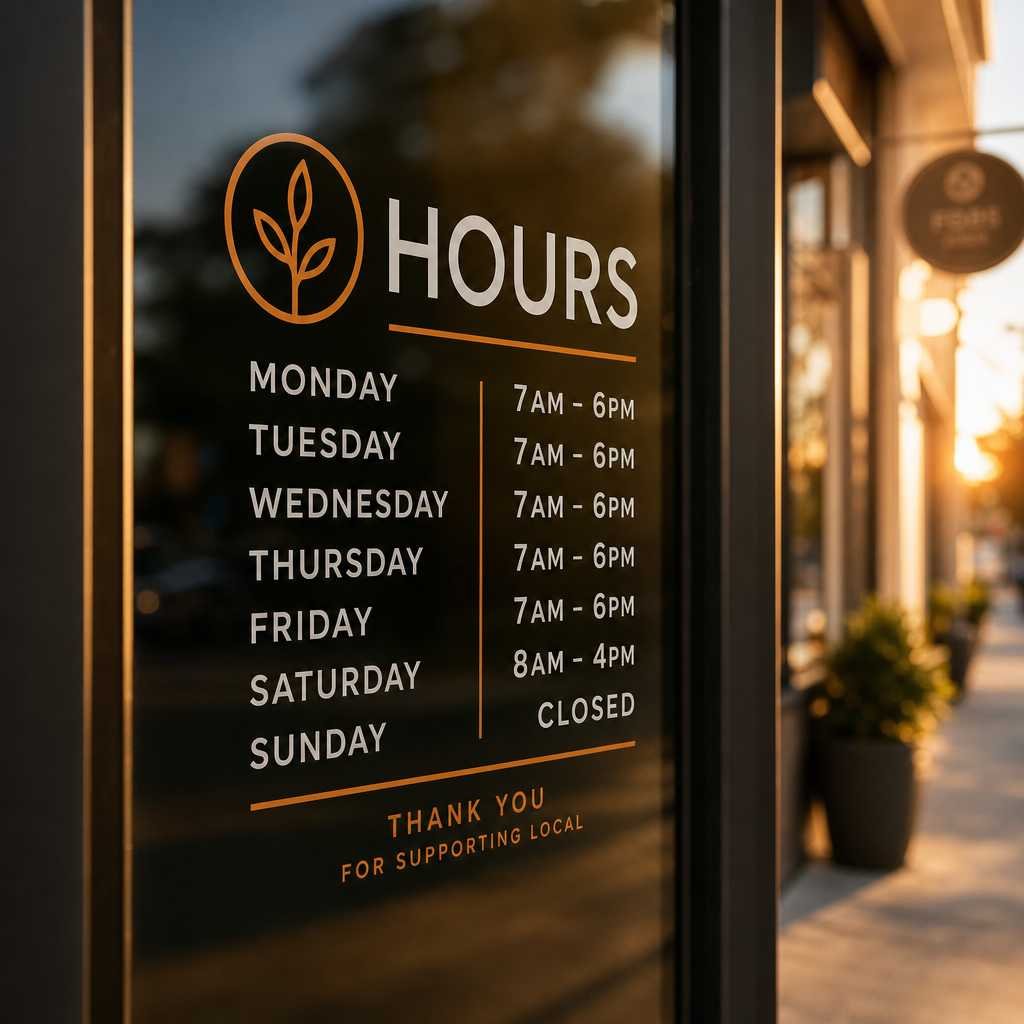
Walk past any retail storefront and you will notice two kinds of business hours displays: crisp vinyl decals that look like they were designed yesterday, and faded paper signs that curl at the corners after one rainy week. The difference is not just cosmetic. It is a direct signal to customers about how seriously you take your business. The debate over custom decals vs printed signs matters more than most small business owners realize, because your hours sign is often the first physical touchpoint a potential customer sees. This article breaks down the real cost, durability, and presentation differences so you can make a decision that actually serves your storefront.
Table of Contents
- Quick Takeaways
- Why Your Hours Sign Matters More Than You Think
- What Custom Vinyl Decals Actually Are
- What Printed Signs Actually Are
- Durability and Weather Resistance
- Cost Comparison: Short-Term vs. Long-Term
- Professional Appearance and Brand Perception
- Comparison Table: Decals vs. Printed Signs vs. DIY Options
- Installation, Maintenance, and Flexibility
- Which Option Actually Wins for Small Businesses
- Frequently Asked Questions
- References
Quick Takeaways
| Key Insight | Explanation |
|---|---|
| Vinyl decals outlast paper signs by years | ORACAL 651 vinyl, used in professional-grade decals, is rated for 6 or more years of outdoor use. Paper signs typically degrade within weeks in sun or rain exposure. |
| The vinyl decal vs paper sign cost equation flips over time | A paper sign may cost less upfront, but replacing it every few months makes it more expensive annually than a single quality vinyl decal. |
| First impressions at the door carry serious weight | According to research cited by Forbes, customers form opinions about a business within the first 7 seconds of physical contact. A faded hours sign contributes to that judgment. |
| Weatherproofing is non-negotiable for exterior signage | Printed paper signs are not UV resistant or waterproof. Professional vinyl decals are both, making them the only realistic option for windows, doors, and outdoor surfaces. |
| Custom decals can match your brand precisely | Unlike generic printed signs, custom vinyl open hours decals can use your exact brand fonts, colors, and logo, reinforcing brand consistency at the entry point of your store. |
| Best business hours sign option depends on surface type | For glass doors and windows, vinyl decals adhere cleanly and remove without residue. Printed signs require tape or frames that look improvised on professional storefronts. |
| Made-in-USA production matters for quality control | Domestically produced vinyl decals from specialists like The Retractable Banner Shop carry more consistent color accuracy and cut precision than overseas mass-produced printed signs. |
Why Your Hours Sign Matters More Than You Think

Most small business owners treat their hours sign as an afterthought. They print something at the office, tape it to the door, and move on. This is a mistake that compounds quietly over time.
Your hours sign is not just informational. It communicates professionalism, permanence, and whether your business is worth trusting with a customer’s time and money. A warped piece of paper with hand-scrawled times says something very specific about your standards, and it is not positive.
In practice, storefront signage is one of the highest-ROI investments a small business can make per dollar spent, precisely because it works passively every hour your doors are closed. Getting it right the first time is not perfectionism. It is basic business sense.
What Custom Vinyl Decals Actually Are
Custom vinyl decals for business hours are precision-cut lettering and graphic elements printed or cut from calendered or cast vinyl film and applied directly to glass, metal, or other smooth surfaces. The professional standard for this application is ORACAL 651, a calendered vinyl with a permanent adhesive rated for exterior use.
These are not the same as budget stickers you order from a mass-market print site. Professional open hours decals are die-cut to shape, color-matched to brand standards, UV laminated or UV-resistant by formula, and designed to adhere to glass without bubbling or peeling under temperature changes.
Why ORACAL 651 Is the Industry Standard
ORACAL 651 is a solvent-cast adhesive vinyl that maintains adhesion across temperature ranges from well below freezing to over 150 degrees Fahrenheit. This matters for storefronts in climates with hot summers and cold winters, where cheaper vinyl cracks, fades, or lifts at the edges within one season.
The Retractable Banner Shop uses ORACAL 651 specifically because it produces sharper cut edges, more accurate color reproduction, and longer service life than the generic vinyl films used by discount sign shops or mass-market competitors.
Pro tip: When ordering a custom open hours decal, always confirm the vinyl specification. If a supplier does not mention ORACAL or a named equivalent, assume they are using commodity film that will fail within 12 to 18 months outdoors.
What Printed Signs Actually Are
Printed signs for business hours range from simple paper printouts to foam-core boards, plastic banners, and laminated card inserts in a frame. What they share is a construction that relies on a substrate (paper, foam, plastic) that is fundamentally separate from the surface it is displayed on.
This matters because the weakest point of any printed sign is how it is attached to your door or window. Tape fails. Suction cups drop. Frame systems look institutional. None of these attachment methods produce the clean, flush, professional appearance of a properly applied vinyl decal.
Where Printed Signs Genuinely Work
To be fair, printed signs do have legitimate use cases. For temporary announcements like holiday closures, short-term promotional hours, or emergency notices, a printed and laminated card is perfectly appropriate. The problem is when businesses use a temporary solution as a permanent fixture.
If your business hours have not changed in six months and your hours sign is still a printed sheet in a plastic sleeve, you have already paid the credibility cost of that decision every single day it has been on your door.
Durability and Weather Resistance
This is where the vinyl decal vs paper sign comparison becomes completely one-sided. Outdoor durability is not a close contest.
ORACAL 651 vinyl is UV resistant, waterproof, and rated for 6 or more years of outdoor exposure. Paper, even laminated paper, is none of those things at any meaningful level. A laminated sheet may survive a few weeks of sun before the laminate begins to separate and yellow. One hard rain against an improperly sealed frame and moisture wicks into the paper, causing bubbling, ink bleed, and edge deterioration.
Temperature Cycling and Adhesion Failure
A common mistake is underestimating how much glass surfaces expand and contract with temperature changes. Standard paper signs attached with tape will peel at the corners in cold weather as the glass contracts and the tape loses adhesion. Professional vinyl decals are formulated to flex with the surface, maintaining adhesion through repeated thermal cycling.
In practice, businesses in northern states often find that paper signs attached in summer are falling off by November. A properly applied vinyl decal on the same door will still be holding perfectly in year three.
“Exterior signage materials must withstand UV radiation, moisture, and thermal stress simultaneously. Only properly formulated vinyl films with UV-resistant inks meet all three criteria for multi-year outdoor performance.” – Sign Industry Technical Standards, referenced by the International Sign Association
Cost Comparison: Short-Term vs. Long-Term
The upfront cost argument for printed signs is real but misleading. A printed sheet costs almost nothing. A quality custom vinyl decal costs more at purchase. But this comparison ignores the replacement cycle.

A paper hours sign in a frame typically needs replacing every 3 to 6 months due to fading, yellowing, or damage. At even modest printing costs, that adds up to 2 to 4 replacements per year. A quality vinyl decal applied once has a service life of 5 to 7 years. Over that same period, the total cost of paper replacements can easily exceed the one-time cost of the vinyl decal several times over.
Hidden Costs of Printed Signs
Beyond material cost, printed signs carry hidden labor costs. Someone on your staff has to notice when the sign looks bad, design or source a replacement, print it, trim it, and reinstall it. That is recurring time cost that is often invisible in a small business because the owner absorbs it personally. A vinyl decal eliminates that recurring task entirely.
Pro tip: Calculate your true cost of printed signs by multiplying the number of replacements per year by the fully loaded time cost of the replacement process, including design, printing, trimming, and reapplication. Most small business owners are surprised to find they spend more than they think maintaining paper signs.
Professional Appearance and Brand Perception
Brand consistency at the point of entry is not a minor detail. The International Sign Association has reported that storefront signage directly influences purchasing decisions and customer return rates. When your hours sign looks polished and intentional, it signals that the rest of your business operation is equally professional.
Custom vinyl open hours decals can be produced in any color, font, or layout that matches your existing brand identity. This is the best business hours sign option for businesses that have invested in a consistent visual brand, because every touchpoint, including your door, should reinforce that identity.
The Credibility Signal at Your Front Door
Customers who arrive outside your hours are still forming an opinion about your business. A professionally applied vinyl decal with clean typography and your logo communicates that you are established, serious, and worth returning to. A taped-up paper printout communicates the opposite, regardless of how good your actual product or service is.
Competitors like Sticker Mule offer generic decal products, but they are not specialized in storefront signage for small businesses. Wall Decal World and Banner Buzz offer broader catalogs but lack the focused expertise in open hours decals that a specialist like The Retractable Banner Shop brings to this specific product category.
Comparison Table: Decals vs. Printed Signs vs. DIY Options
| Feature | Custom Vinyl Decal (ORACAL 651) | Printed Sign (Laminated Paper or Foam Core) | DIY Vinyl or Craft Store Decal |
|---|---|---|---|
| Outdoor Durability | 6 to 7 years rated | 1 to 6 months before degradation | 1 to 2 years, inconsistent |
| UV Resistance | Yes, professional grade | No (laminate helps minimally) | Partial, depends on product |
| Waterproof | Yes, fully sealed adhesive film | No (laminate delays but does not prevent) | Varies by brand and application |
| Brand Customization | Full: fonts, colors, logos, layouts | Limited by print quality and substrate | Very limited, craft-grade results |
| Application Method | Direct adhesive to glass, no frame needed | Tape, suction cups, or frames | Adhesive, often unreliable on glass |
| Replacement Frequency | Once every 5 to 7 years | 2 to 4 times per year | 1 to 2 times per year |
| Professional Appearance | High: flush, clean, intentional | Low: improvised appearance | Medium at best, often inconsistent |
| Long-Term Cost | Lowest over a 5-year period | Highest due to recurring replacement | Moderate with recurring effort |
Installation, Maintenance, and Flexibility
One concern small business owners raise about vinyl decals is flexibility: what happens when your hours change? This is a valid question, but it is based on a misunderstanding of how modern custom decals work.
Professional vinyl decals applied to glass surfaces with a quality adhesive can be removed cleanly without leaving residue, particularly when removed within the first few years of application. If your hours change seasonally, you can order a new decal for the seasonal schedule and swap it out. The cost of a replacement decal is still lower than the accumulated cost of a year’s worth of paper sign replacements.
Application Is Simpler Than Most People Expect
Custom open hours decals from The Retractable Banner Shop come with application instructions and transfer tape already applied, making the installation process straightforward for any business owner without a sign installation background. The process involves cleaning the glass surface, positioning the decal, and using a squeegee to smooth it down. Total time is typically under 10 minutes per sign.
Compare that to the ongoing maintenance of a printed sign frame system, which involves periodic cleaning of the frame, replacement of the insert, and dealing with frames that warp, discolor, or lose their mounting hardware over time.
Which Option Actually Wins for Small Businesses
The answer is clear. For any permanent or semi-permanent display of business hours on a storefront, custom vinyl decals win across every meaningful metric: durability, appearance, long-term cost, and brand consistency.
Printed signs serve a narrow legitimate purpose: temporary notices with a lifespan measured in days or a few weeks. Using them for business hours, which are stable information that customers rely on repeatedly, is the wrong tool for the job.
For small businesses and retailers who want their storefront to communicate professionalism from the first moment a customer arrives, a custom open hours decal made with ORACAL 651 vinyl is the only option worth serious consideration. The upfront investment is modest, the service life is years long, and the credibility benefit starts the moment it goes on your door.
Frequently Asked Questions
How long do custom vinyl open hours decals typically last outdoors?
Professional-grade vinyl decals made with ORACAL 651 are rated for 6 or more years of outdoor use when properly applied to a clean glass surface. In practice, many decals remain in excellent condition for 7 to 8 years before any visible fading or edge lifting occurs, particularly in moderate climates.
Can I remove a vinyl hours decal if my business hours change?
Yes. Vinyl decals applied to glass surfaces can be removed cleanly, especially within the first few years of application. Using a plastic scraper and a small amount of adhesive remover leaves the glass undamaged and ready for a new decal. This is one reason custom vinyl is superior to etched or permanent painted signage for information that may need updating.
Are custom decals actually more cost-effective than printed signs over time?
Yes, clearly. A quality vinyl hours decal purchased once lasts 5 to 7 years. A paper or foam-core printed sign typically needs replacing 2 to 4 times per year due to fading, moisture damage, or physical wear. When you calculate the total material and labor cost over a 5-year period, the vinyl decal is almost always less expensive in total, often significantly so.
What surfaces can custom open hours decals be applied to?
Custom vinyl decals adhere well to any smooth, clean, non-porous surface including glass doors, glass windows, painted metal doors, and smooth plastic panels. They are not suitable for textured or rough surfaces like brick, stucco, or raw wood, where adhesion will be unreliable. For storefronts, glass is the primary application surface and vinyl decals perform extremely well on it.
How do custom vinyl decals compare to generic decal options from mass-market suppliers?
The key differences are vinyl quality, cut precision, and brand customization. Mass-market suppliers like Sticker Mule use standardized production processes that prioritize volume over precision for specialty applications. Specialist retailers like The Retractable Banner Shop produce decals specifically designed for storefront open hours display, with custom sizing, brand-matched colors, and professional-grade ORACAL 651 vinyl that mass-market options typically do not use.
Is there a best practice for positioning an open hours decal on a glass door?
Yes. The standard professional placement for an open hours decal on a glass door is at approximately eye level, positioned on the interior-facing surface of the glass to protect it from direct weathering, or on the exterior with a UV-resistant vinyl formulation. Eye level is typically 58 to 62 inches from the floor to the center of the decal. This ensures maximum visibility for customers of all heights without requiring them to search for the information.
Have you recently switched from printed signs to vinyl decals for your business hours, or are you still weighing your options? Share what has worked or what questions you still have in the comments below.
References
- Forbes Business Coverage: research and analysis on small business branding, storefront marketing, and first-impression statistics for retail establishments
- Statista Market Research: data on retail signage effectiveness, small business expenditure on physical marketing, and consumer response to storefront presentation
- U.S. Small Business Administration: guidance on physical marketing investments, signage regulations, and cost management strategies for small and independent retailers
- International Sign Association: technical standards and industry research on exterior signage materials, durability requirements, and best practices for commercial signage installations
- HubSpot Marketing Statistics: consumer behavior data relevant to physical brand touchpoints, customer trust signals, and first-impression research for brick-and-mortar businesses