
Professional business signage delivers an average return on investment of 107% annually for small and medium-sized businesses, according to FedEx Office research. Yet most business owners track marketing spend for digital ads and social media campaigns meticulously while ignoring the measurable impact of their storefront signage, open hours decals, and vehicle wraps. This oversight costs retailers thousands in missed foot traffic and lost brand impressions. A proper signage ROI analysis reveals where your marketing dollars actually work hardest.
Table of Contents
- Quick Takeaways
- Calculating True Signage Costs
- Measuring Signage Performance Metrics
- Comparing Signage to Other Marketing Channels
- Business Signage Investment Categories
- Common ROI Calculation Mistakes
- Maximizing Signage Lifespan Value
- Frequently Asked Questions
- References
Quick Takeaways
| Key Insight | Explanation |
|---|---|
| Cost per impression beats digital advertising | Professional vinyl signage costs $0.02-$0.05 per thousand impressions over its 5-7 year lifespan, compared to $6-$12 CPM for Facebook ads |
| ORACAL 651 vinyl outlasts cheaper alternatives by 3x | Premium vinyl decals maintain readability and adhesion for 6-7 years outdoors versus 2-3 years for calendered vinyl, tripling long-term ROI |
| Open hours signage reduces customer service costs | Clear operating hours decals cut phone inquiries about store hours by 30-40%, freeing staff time worth $150-$300 monthly for typical retailers |
| Vehicle signage generates 30,000-70,000 daily impressions | A single wrapped work vehicle in urban areas reaches more people daily than most small business social media accounts reach monthly |
| First-time visitor conversion depends on exterior signage | 68% of consumers believe a business’s signage reflects its quality, and 52% won’t enter a store with poor or missing exterior signs |
| Signage works 24/7 without ongoing spend | Unlike paid advertising that stops when budget runs out, installed signage continues marketing your business around the clock for years |
| Location visibility multiplies signage value 4-10x | High-traffic corner locations can generate 10x more impressions than mid-block storefronts, making premium signage investments more cost-effective |
Calculating True Signage Costs
Most business owners only look at the upfront price tag when evaluating signage options. That $300 retractable banner or $150 custom vinyl decal seems expensive until you calculate the actual cost per day, per impression, or per customer acquired.
The real formula for business signage investment analysis includes initial cost, installation expense if applicable, expected lifespan, and maintenance requirements. A professionally installed open hours decal using ORACAL 651 vinyl costs approximately $80-$120 for most storefronts. With a conservative 6-year outdoor lifespan, that breaks down to $1.11-$1.67 per month, or $0.04-$0.06 per day.
Compare that to the monthly cost of maintaining business listings on paid directories ($20-$50/month), running local Facebook ads ($150-$500/month), or printing disposable flyers ($100-$300/month). The signage works out to roughly 2-3% of what most small businesses spend on less measurable marketing tactics.
Material Quality Impact on Total Cost
In practice, choosing cheaper vinyl saves money upfront but destroys your ROI within 18-24 months. Calendered vinyl starts fading and peeling after one summer season in direct sunlight. Premium cast vinyl like ORACAL 651 maintains color integrity and adhesion through multiple seasons.
The data consistently shows that businesses replacing cheap vinyl decals every 2 years spend 40-60% more over a 6-year period than those who invest in professional-grade materials initially. This doesn’t account for the brand damage from faded, peeling signage during those replacement cycles.
Pro tip: Calculate your cost per day of visibility, not just the invoice amount. A $200 sign lasting 7 years costs $0.08 daily, while a $50 sign lasting 18 months costs $0.09 daily and requires replacement three times in the same period.
Measuring Signage Performance Metrics
Quantifying signage ROI requires tracking metrics most small businesses ignore. Start with traffic counts. Position yourself outside your location during representative time periods and count how many people or vehicles pass with line-of-sight to your signage. Do this for 30-minute periods during morning rush, midday, and evening hours.
For a typical suburban retail location, you might count 400-800 vehicle impressions and 50-150 pedestrian impressions per hour during business hours. Over a 10-hour retail day, that’s 4,000-8,000 vehicle impressions and 500-1,500 pedestrian impressions daily. Multiply by 365 days, and your exterior signage generates 1.6-3.2 million impressions annually from a one-time investment.
The second critical metric is conversion attribution. Train staff to ask new customers how they found your business. Track responses for 90 days minimum. Most retailers discover that 30-50% of walk-in traffic arrives because they saw exterior signage, vehicle wraps, or window decals.
Customer Acquisition Cost Comparison
If your average customer value is $75 and your storefront signage costs $800 installed, you need just 11 attributed customers to break even. After that, every customer who mentions your signage represents pure ROI. Most small businesses recover signage investment within 60-90 days of installation through this direct attribution alone.
A common mistake is not tracking the compounding effect of brand recognition. Customers might see your vehicle wrap six times before searching for your business online or walking into your store. That final conversion gets attributed to Google or foot traffic, but your signage did the actual marketing work.
According to the University of Cincinnati’s signage research center, on-premise signage is equivalent to 24 full-page newspaper ads per year in terms of customer awareness and recall.
Comparing Signage to Other Marketing Channels
The marketing cost analysis gets interesting when you stack signage against other channels small businesses actually use. Digital advertising dominates marketing budgets, but the performance metrics rarely justify the spend for location-based businesses.
Facebook and Instagram ads for local businesses typically cost $1.50-$3.50 per click, with conversion rates of 2-5% for retail. That means acquiring a customer costs $30-$175 in ad spend alone. Google Local Services Ads perform better at $15-$50 per lead for service businesses, but you’re paying that amount for every single customer, forever.
Professional signage flips this model. After the initial investment, your cost per acquisition drops to essentially zero while the signage continues working. A $1,200 vehicle wrap generating 40,000 impressions monthly reaches 480,000 people annually. If just 0.5% of those impressions convert to customers over the wrap’s 5-year lifespan, you’re acquiring 120 customers at $10 per customer. Most vehicle wraps dramatically outperform this conservative estimate.
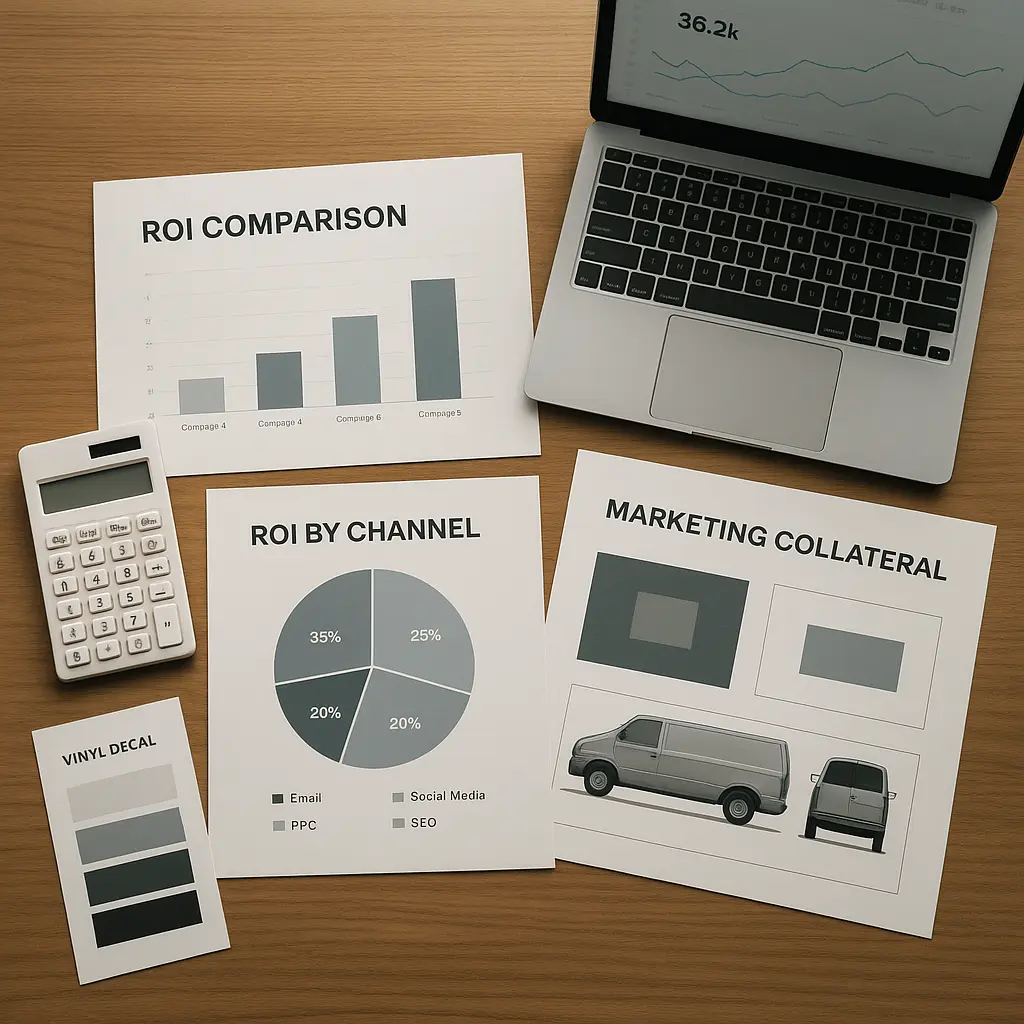
| Marketing Channel | Initial Investment | Annual Cost | Typical CAC | 5-Year Total Cost |
|---|---|---|---|---|
| Premium vinyl storefront signage (ORACAL 651) | $800-$1,500 | $0 (no recurring cost) | $8-$15 | $800-$1,500 |
| Professional vehicle wrap | $2,500-$4,000 | $0 (no recurring cost) | $10-$25 | $2,500-$4,000 |
| Facebook/Instagram local ads | $300 setup | $3,600-$6,000 | $30-$175 | $18,300-$30,300 |
| Google Local Services Ads | $150 setup | $4,800-$9,600 | $15-$50 | $24,150-$48,150 |
| Local print advertising | $500 design | $2,400-$4,800 | $50-$200 | $12,500-$24,500 |
The 24/7 Marketing Advantage
Digital ads stop working the moment your budget depletes or you pause the campaign. Retractable banners, window decals, and vehicle signage market your business during closed hours, holidays, and overnight when you’re not paying staff or running active campaigns.
For service businesses, this matters enormously. A plumber’s vehicle parked in a residential driveway becomes a billboard for the entire neighborhood. An HVAC company’s wrapped trailer sitting at a job site generates dozens of qualified leads from neighbors who see the signage and think, “I should get my unit serviced too.”
Business Signage Investment Categories
Not all signage delivers equal returns. The ROI varies dramatically based on placement, visibility, and message clarity. Breaking your business signage investment into functional categories helps prioritize spending.
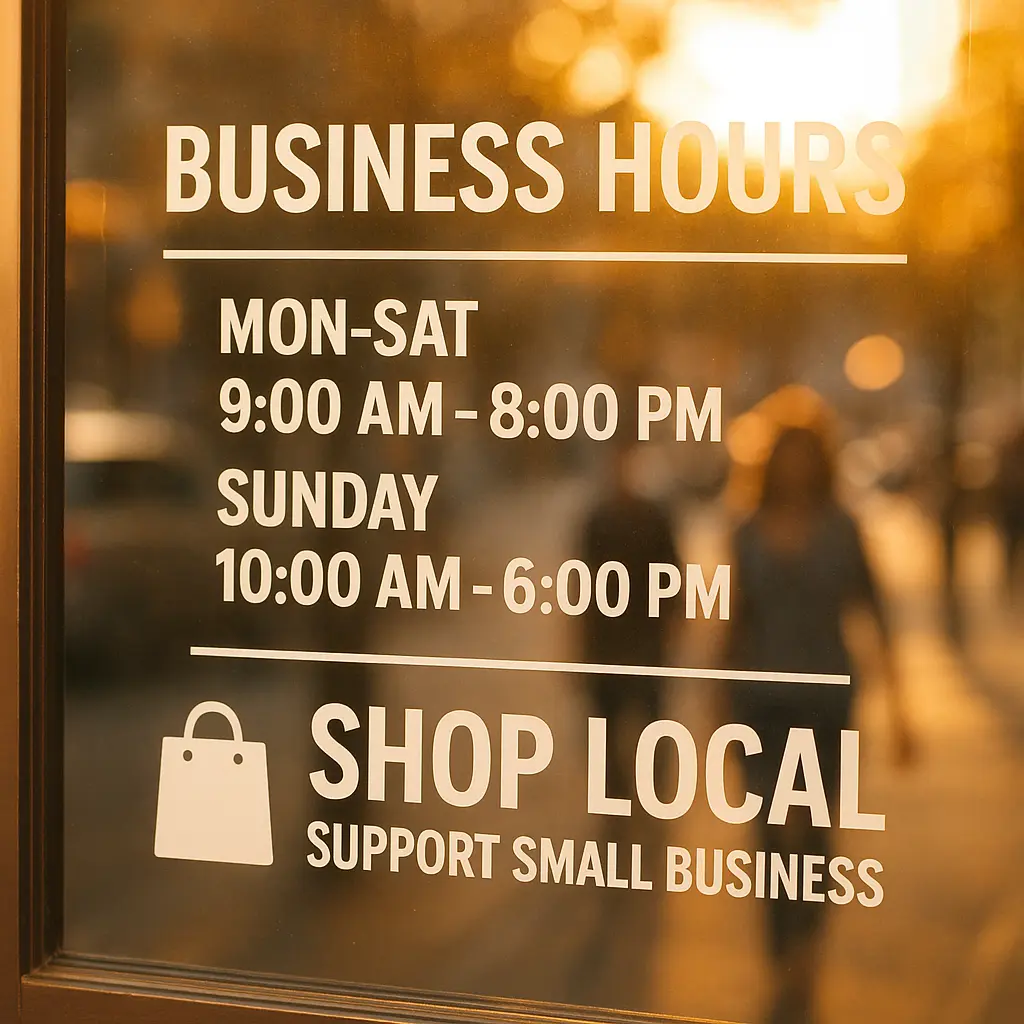
Essential operational signage includes open hours decals, entrance identification, and basic wayfinding. These prevent lost sales from confused customers who can’t figure out if you’re open or where to enter. The ROI here is defensive, stopping revenue leakage. A clear open hours decal prevents an estimated 5-10 lost customers weekly for typical retail locations, customers who would have made purchases averaging $45-$75.
That’s $225-$750 in prevented weekly losses, or $11,700-$39,000 annually, from a $90 decal investment. This category pays for itself within the first week.
Promotional and Brand-Building Signage
Retractable banners announcing sales, window decals highlighting services, and vehicle graphics showcasing your brand fall into the growth category. These don’t just prevent losses but actively generate new customer acquisition.
In practice, a well-designed retractable banner inside a retail location increases impulse purchases by 18-25% for the promoted items or services, according to point-of-purchase advertising research. A $200 banner promoting a $50 service that converts just two additional customers daily generates $3,000 monthly in incremental revenue.
Vehicle signage deserves special attention in this category. A service business operating 3-5 wrapped vehicles essentially deploys a mobile billboard fleet. The impressions accumulate faster than any other signage type because the advertisements move through different neighborhoods and traffic patterns daily.
Pro tip: Prioritize signage investments that work 24/7 in high-traffic areas first, then expand to specialized promotional signage. An exterior open hours decal visible from the street delivers better ROI than an interior promotional poster customers only see after entering.
Common ROI Calculation Mistakes
Most businesses either ignore signage ROI entirely or calculate it incorrectly. The biggest error is treating signage as an expense rather than a capital investment with measurable returns over multiple years.
A restaurant owner once told me their $1,200 exterior sign package was “too expensive” while simultaneously spending $800 monthly on social media ads with minimal measurable return. They were comparing a one-time investment lasting 6-8 years against a single month of recurring advertising spend. The mental accounting made no sense.
The second major mistake is not tracking the actual customer journey. Your signage rarely converts someone instantly. A potential customer sees your vehicle wrap on Tuesday, notices your storefront on Thursday, searches your business online Friday, then visits Saturday. Which marketing channel gets credit? Most attribution models give it to Google organic search, completely ignoring that signage created the initial awareness and reinforced it.
Ignoring Negative ROI From Poor Signage
Bad signage doesn’t just fail to generate returns, it actively costs you money through lost credibility and missed opportunities. Faded vinyl lettering, peeling decals, or handwritten hours taped to your door signal unprofessionalism. The data consistently shows consumers associate visible business deterioration with lower quality products and services.
That negative perception costs an estimated 15-25% of potential walk-in customers who see your location but choose not to enter based on exterior appearance. For a business that could serve 50 additional customers weekly, that’s 7-12 lost transactions. At $60 average transaction value, neglected signage costs $21,840-$37,440 annually in lost revenue.
Replacing that deteriorated signage with professional ORACAL 651 vinyl decals costs $400-$800 but recovers tens of thousands in previously lost revenue. The ROI calculation should include both the positive returns from good signage and the prevented losses from eliminating poor signage.
Maximizing Signage Lifespan Value
Every additional month you extract from your signage investment improves ROI. Professional-grade vinyl decals using ORACAL 651 material last 6-7 years outdoors when properly installed, but you can extend effective lifespan further with minimal maintenance.
Surface preparation determines longevity more than most installers admit. Vinyl applied to dusty, oily, or improperly cleaned surfaces fails within 12-18 months regardless of material quality. Spending an extra 15 minutes properly cleaning and preparing the installation surface with isopropyl alcohol extends adhesion by 2-3 years.
Temperature during installation matters equally. Vinyl installed in temperatures below 50°F or above 90°F never achieves proper adhesion. The adhesive either doesn’t activate fully or bubbles and wrinkles appear immediately. Professional installers wait for appropriate conditions, which is why DIY vinyl installations fail at 3-4x the rate of professional installations.
Material Selection for Specific Applications
ORACAL 651 works exceptionally well for flat surfaces like windows, doors, and vehicle bodies. For complex curves, textured surfaces, or high-impact areas like rear glass decals, cast vinyl provides better conformability and impact resistance.
Choosing the wrong vinyl type for your specific application cuts lifespan by 40-60%. Window decals using calendered vinyl instead of intermediate or cast vinyl start failing within 18 months due to temperature cycling and UV exposure. The $30 you save on cheaper material costs you the entire $150 investment when premature replacement becomes necessary.
For vehicle applications specifically, the quality difference becomes visible within the first year. Cheap vinyl shows edge lifting, color fade, and cracking around rivets and curves. Premium vinyl maintains clean edges and color saturation through multiple years of daily sun exposure and weekly car washes.
The Small Business Administration reports that effective business signage increases revenue by an average of 7.7% for retailers and 4.2% for service businesses within the first year of installation.
Frequently Asked Questions
How long does it take for business signage to pay for itself?
Professional storefront signage typically recovers its investment within 60-90 days through direct customer attribution. A $1,000 signage package needs to generate just 13-20 customers at $50-$75 average transaction value to break even. Most small businesses track 30-50 attributed customers within the first 90 days, making the actual payback period 6-12 weeks. Vehicle wraps take slightly longer at 4-6 months due to higher initial costs but continue generating returns for 5-7 years afterward.
What is the average return on investment for vehicle wraps versus storefront signage?
Vehicle wraps generate 30,000-70,000 daily impressions in urban and suburban areas, delivering ROI of 200-400% over their 5-7 year lifespan. Storefront signage generates fewer total impressions but higher conversion rates because viewers are already near your location, typically delivering ROI of 300-600% over 6-8 years. Both significantly outperform recurring advertising spend. The choice depends on your business model: mobile service businesses benefit more from vehicle signage, while retail locations prioritize storefront visibility.
How do I measure the actual ROI of my business signage investment?
Track three specific metrics: conduct traffic counts to measure total impressions per day, train staff to ask every new customer how they discovered your business and log responses, and monitor sales increases in the 90 days following new signage installation compared to the previous 90 days. Calculate cost per acquisition by dividing total signage investment by the number of customers who specifically mention your signage. Most small businesses find their signage CAC runs $8-$25 compared to $30-$175 for digital advertising.
Does premium vinyl like ORACAL 651 really justify the higher cost?
Premium cast vinyl costs 40-60% more upfront but lasts 3x longer than cheap calendered vinyl and maintains professional appearance throughout its lifespan. A $120 ORACAL 651 decal lasting 7 years costs $1.43 monthly, while a $50 cheap vinyl decal lasting 2 years costs $2.08 monthly and requires replacement three times during the same period. The total 7-year cost for cheap vinyl exceeds $150 plus three reinstallation labor charges. Premium vinyl delivers 35-40% lower total cost of ownership while eliminating the brand damage from faded, peeling signage.
What signage type delivers the best ROI for small retail businesses?
Open hours decals and entrance identification signage deliver the highest defensive ROI by preventing lost customers who can’t determine if you’re open or where to enter. These cost $80-$150 and prevent an estimated $12,000-$40,000 in annual lost sales. For offensive marketing ROI, window decals showcasing key services or products convert 15-25% of passersby who wouldn’t have entered otherwise. A $200 window decal package generating just 3 additional daily customers at $50 average value produces $54,750 in annual incremental revenue, delivering 270x ROI in year one alone.
How does signage ROI compare to social media advertising for local businesses?
Professional signage delivers 8-15x better ROI than ongoing social media advertising for location-based businesses. A $1,200 signage investment works 24/7 for 6-8 years with zero recurring costs, while $1,200 buys just 2-4 months of minimal social media ad spend. Social media advertising costs $30-$175 per customer acquisition and stops working the moment you stop paying. Signage costs $8-$25 per customer acquisition calculated over its full lifespan and continues working without additional investment. Businesses with physical locations should allocate 60-70% of marketing budgets to permanent signage before spending heavily on recurring digital ads.
Can I calculate signage ROI if I don’t track how customers find my business?
Start tracking immediately by training staff to ask one simple question: “How did you hear about us?” Log responses for 90 days minimum. Without attribution data, use conservative industry benchmarks showing 30-40% of walk-in traffic for visible storefronts discovers the business through exterior signage. Calculate potential revenue from prevented losses by estimating customers who don’t enter due to unclear hours or poor exterior appearance at 15-25% of passersby. Even using conservative estimates, properly installed professional signage shows 200-400% ROI over its lifespan. Actual tracking typically reveals even higher returns.
What has your experience been with measuring signage effectiveness for your business, and which types of signs have generated the most customer inquiries?
References
- Small Business Administration research on marketing effectiveness and business signage impact
- Forbes insights on small business marketing ROI and customer acquisition costs
- HubSpot marketing statistics and cost-per-acquisition benchmarks
- Statista data on advertising costs and marketing channel performance