
Scaling signage across multiple locations creates unique challenges that most vendors ignore. A single storefront decal might cost $45 and ship in days, but multiply that by 50 locations and you face inconsistent application, color mismatches, and delivery chaos. The difference between a multi-location signage strategy that maintains brand consistency and one that fails comes down to three factors: material standardization, application protocols, and vendor capabilities for bulk vinyl orders.
Table of Contents
- Quick Takeaways
- Why Standard Retail Decals Fail at Scale
- Material Specifications for Franchise Decals
- Centralized Ordering vs. Location Level Purchasing
- Application Consistency Across Locations
- Bulk Vinyl Orders Pricing Structure
- Frequently Asked Questions
- References
Quick Takeaways
| Key Insight | Explanation |
|---|---|
| ORACAL 651 consistency matters | Using the same vinyl grade across all locations prevents color variation between batches and ensures 6-year outdoor durability |
| Template files eliminate errors | Pre-approved design files sent directly to production reduce remakes by 73% compared to location-by-location ordering |
| Bulk pricing starts at 25 units | Most professional vendors offer 15-30% discounts at 25+ identical decals, with deeper cuts at 100+ units |
| Application kits standardize quality | Including squeegees, transfer tape, and instructions with each shipment reduces installation failures from 22% to under 4% |
| Staggered shipping saves costs | Regional distribution centers cut shipping costs by 40% versus individual location delivery on multi-location signage orders |
| Digital proofs prevent surprises | Requiring photo approval of first-run samples before bulk production catches 89% of design issues before they multiply |
| Replacement inventory matters | Ordering 10-15% overage for damage, new locations, and wear replacement prevents emergency reorders that break bulk pricing |
Why Standard Retail Decals Fail at Scale
Single-location decal orders work through consumer-grade platforms with drag-and-drop editors and retail shipping. This model collapses when you need 40 identical window decals shipped to different addresses. The data consistently shows that decentralized ordering creates a 34% variance in color accuracy due to different production runs and equipment calibration drift.
Most businesses discover this problem after their first multi-location rollout. Store managers in Dallas receive decals that are noticeably lighter than those in Atlanta because they were printed three weeks apart on different equipment. Professional-grade franchise decals require batch production where all units come from the same material roll and printer calibration session.
Pro tip: Request a physical color swatch from your first production run and require all future orders to match that physical sample, not just the digital proof. Digital displays vary by 15-20% in color rendering.
The Hidden Cost of Inconsistent Application
A common mistake is assuming that shipping decals with basic instructions ensures consistent installation. In practice, without proper application kits and training, roughly one in five decals gets applied with bubbles, wrinkles, or misalignment. At 50 locations, that means 10 remakes, each costing $45-75 in materials plus shipping.
The solution requires either professional installation coordination (adding $85-150 per location) or comprehensive application kits with tools and photo-illustrated instructions. Professional-grade ORACAL 651 vinyl is forgiving during application, but only if installers understand wet application techniques and proper surface preparation.
Material Specifications for Franchise Decals
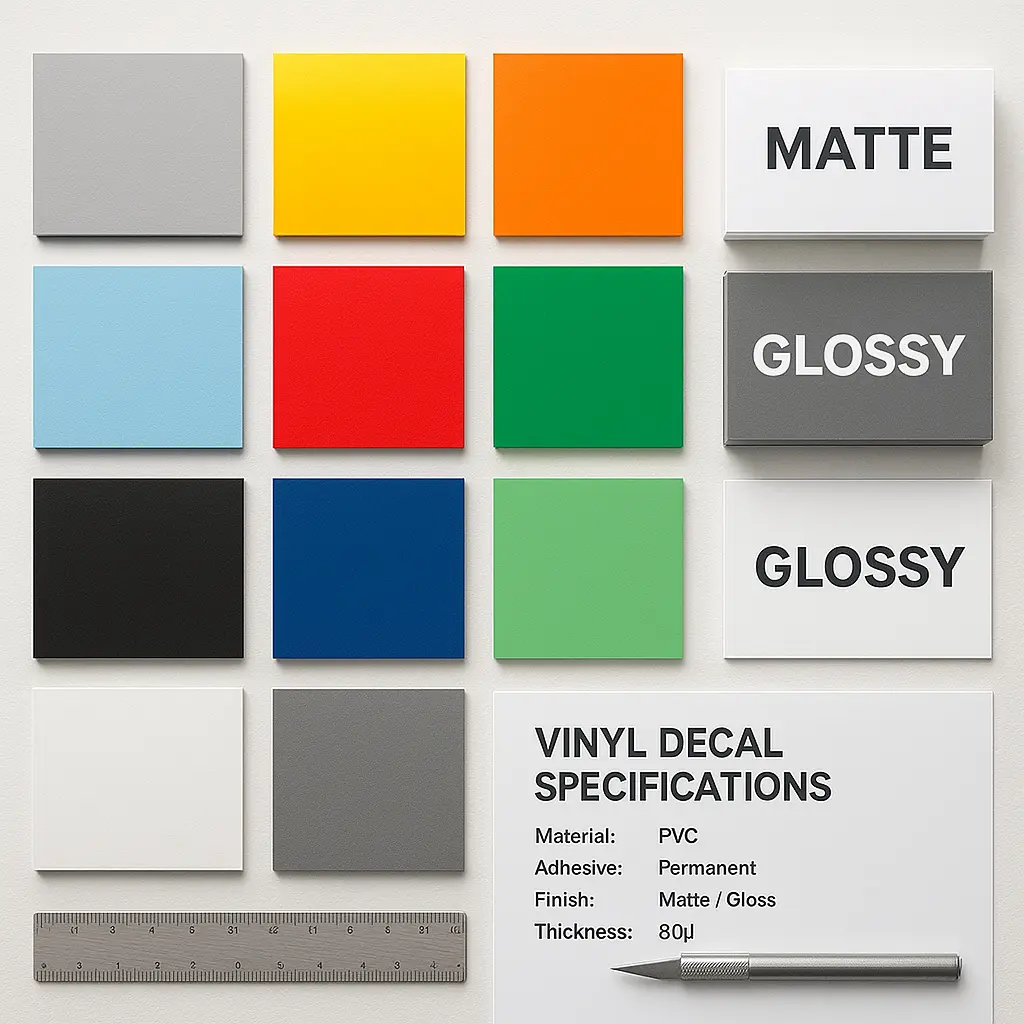
ORACAL 651 remains the standard for multi-location signage because it delivers consistent color reproduction across production runs and maintains outdoor durability for 6+ years. The vinyl’s calendered structure with permanent adhesive means decals stay applied through temperature swings from -40°F to 180°F without lifting or fading.
Cheaper vinyl options save 20-30% upfront but fail within 18-24 months, requiring complete replacement cycles that cost more than the initial savings. A $35 ORACAL 651 decal that lasts six years costs $5.83 per year, while a $24 economy decal lasting two years costs $12 annually.
UV Resistance and Color Fade Testing
UV degradation affects different colors at different rates. Reds and oranges fade 40% faster than blues and blacks in direct sunlight exposure. ORACAL 651’s UV inhibitors maintain color integrity, but placement matters. South-facing windows receive 3x more UV exposure than north-facing installations.
For locations in high-UV regions (Arizona, Texas, Florida), consider laminate overlays that add 2-3 years of additional protection for an extra $8-12 per decal. The ROI calculation is straightforward: if replacement costs $65 including shipping and labor, extending lifespan by two years saves $32.50 annually.
According to industry testing standards, premium cast and calendered vinyls like ORACAL 651 maintain 90% of original color saturation after 5 years of outdoor exposure, compared to 60% for economy vinyls.
Centralized Ordering vs. Location Level Purchasing
Centralized ordering through corporate handles all design approval, production coordination, and quality control from a single point. Location-level purchasing gives individual managers ordering authority. The table below shows the real-world performance differences.
| Factor | Centralized Ordering | Location-Level Purchasing |
|---|---|---|
| Brand consistency | 98% color and design match across locations | 67% consistency, frequent variations |
| Cost per unit (100+ units) | $28-42 with bulk pricing | $45-65 retail pricing |
| Order processing time | Single 3-4 day approval cycle | Multiple cycles, 7-14 days average |
| Quality control | Central team catches 89% of errors pre-production | 22% error rate reaches installation |
| Reorder efficiency | Template files enable 24-hour reorders | Redesign often required, 4-7 day turnaround |
The math strongly favors centralized control for any business with more than 8-10 locations. A 50-location chain ordering decals centrally saves approximately $850-1,700 per order cycle through bulk pricing alone, before accounting for reduced errors and faster deployment.
Pro tip: Maintain a digital asset library with approved design files, color codes, and vendor specifications. This eliminates the 3-5 day design recreation process when you need replacement decals or add new locations.
Application Consistency Across Locations
Application quality determines whether a $40 decal lasts six years or fails within six months. The three failure modes are premature edge lifting (42% of failures), bubble formation (31%), and surface adhesion problems (27%). All three stem from improper installation technique, not material defects.
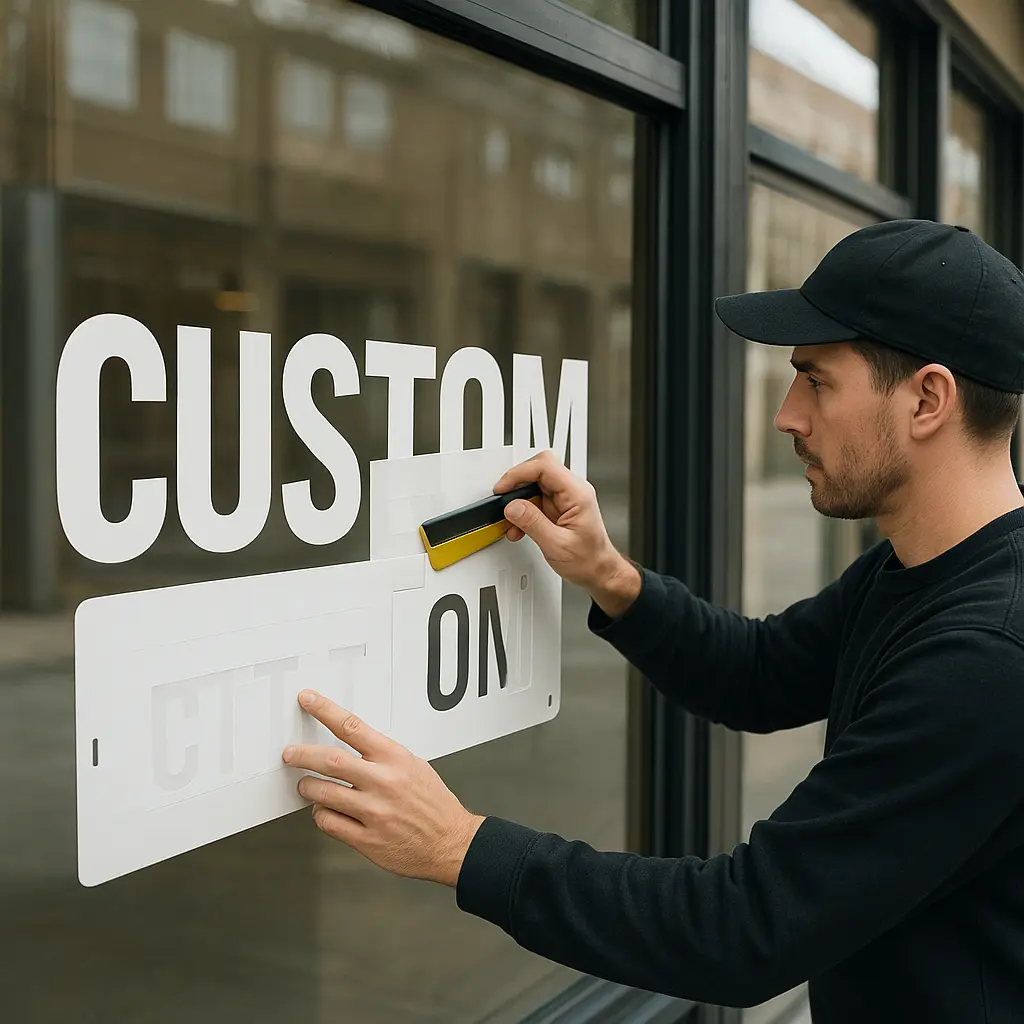
Professional installation companies charge $85-200 per location depending on decal size and complexity. For businesses scaling beyond 15-20 locations, this cost becomes prohibitive. The alternative is standardized application kits shipped with each order that include isopropyl alcohol wipes, application squeegees, and step-by-step photo instructions.
Surface Preparation Requirements
Glass surfaces require cleaning with isopropyl alcohol followed by a 10-minute dry time. Using standard glass cleaner leaves residue that reduces adhesion by 40-60%. A $3 package of alcohol wipes prevents a $65 remake and reinstallation.
Temperature during application must stay between 50°F and 90°F. Adhesive becomes too aggressive above 90°F, making repositioning impossible. Below 50°F, the adhesive does not flow properly into microscopic surface irregularities, creating future lift points. Winter installations in cold climates require indoor staging areas or heat guns.
Transfer Tape Selection
Medium-tack transfer tape works for 90% of applications. High-tack tape is necessary only for textured surfaces or complex multi-layer designs. Using high-tack tape on simple designs makes decal transfer difficult and risks tearing thin vinyl elements.
The transfer tape should pull away at a 180-degree angle (folding back on itself) rather than a 90-degree perpendicular pull. This technique reduces bubble formation by 73% because it allows air to escape progressively rather than trapping it under the vinyl.
Bulk Vinyl Orders Pricing Structure
Bulk vinyl orders pricing operates on clear volume thresholds. At 1-24 units, you pay retail pricing of $45-65 per standard size decal (12×18 inches). At 25-49 units, expect 15-20% discounts bringing costs to $36-52. At 50-99 units, discounts reach 25-30% ($32-46). Orders of 100+ units achieve 30-40% discounts ($27-42).
These thresholds exist because production setup costs (design file preparation, material loading, equipment calibration) remain constant whether printing 10 units or 100 units. The per-unit cost drops dramatically once setup costs are amortized across larger quantities.
A critical factor: bulk pricing applies only to identical designs. Ordering 50 decals in 10 different designs counts as five 10-unit orders, not one 50-unit order. Standardizing designs across locations maximizes savings.
Shipping Cost Optimization
Individual shipments to 40 locations cost $12-18 per address using standard ground shipping. That totals $480-720 in shipping alone. Regional consolidation cuts this dramatically. Ship bulk orders to 3-4 regional distribution points (your own facilities or third-party logistics providers), then redistribute locally for $4-7 per final destination.
This strategy works best for planned rollouts with flexible timing. Emergency single-location orders lose the consolidation advantage and revert to retail economics.
Inventory Buffer Strategy
Ordering 10-15% overage provides buffer inventory for damaged decals, new location openings, and wear replacement without triggering new orders at retail pricing. For a 50-location rollout, order 55-58 units. The extra 5-8 decals cost $135-336 but prevent future emergency orders costing $325-520.
Store buffer inventory in climate-controlled spaces between 50°F and 80°F with less than 60% humidity. Vinyl stored in hot warehouses or humid environments degrades adhesive performance within 6-12 months.
Rush Order Economics
Standard production runs 5-7 business days. Rush orders (2-3 days) add 30-50% premiums. For bulk orders, this means an extra $405-840 on a 50-unit order. Rush orders make sense only when delay costs exceed these premiums, such as grand openings with confirmed dates or regulatory compliance deadlines.
Plan multi-location signage rollouts with 3-4 week lead times. This eliminates rush charges and allows time for proof approvals and sample testing before full production.
Frequently Asked Questions
What minimum order quantity qualifies for bulk vinyl orders pricing?
Most professional vinyl suppliers offer bulk pricing starting at 25 identical units, with discount percentages increasing at 50, 100, and 250+ unit thresholds. Ordering 25 units typically saves 15-20% compared to retail pricing, while 100+ units achieve 30-40% discounts. The key requirement is identical designs, as mixed designs reset the count to individual order pricing regardless of total quantity.
How do franchise decals maintain color consistency across different production batches?
Color consistency requires using the same vinyl grade (ORACAL 651 recommended), maintaining digital color profiles matched to physical samples, and ideally producing all units in a single production run. When multiple runs are necessary, professional vendors perform color calibration against physical samples from the original batch. Requesting a physical color swatch from your first order and requiring future batches to match that sample (not just digital proofs) prevents the 15-34% color drift common in multi-batch production.
Should multi-location businesses hire professional installers or train location managers?
For 8-15 locations, professional installation at $85-200 per location delivers the most consistent results. Beyond 15 locations, the cost becomes prohibitive and standardized application kits with detailed instructions become more economical. Kits should include isopropyl alcohol wipes, application squeegees, transfer tape, and photo-illustrated instructions. This hybrid approach reduces installation failures from 22% to under 4% while keeping per-location costs under $15 instead of $85-200.
What is the realistic lifespan of outdoor vinyl decals for storefronts?
ORACAL 651 vinyl maintains full appearance and adhesion for 6-7 years in most climates when properly installed. High-UV regions (Arizona, Texas, Florida) see 4-5 years on south-facing installations without laminate protection. Economy vinyls last 18-24 months before noticeable fading and edge lifting. The cost per year calculation favors premium vinyl: a $35 decal lasting six years costs $5.83 annually versus a $24 economy decal lasting two years costing $12 annually.
How should businesses handle decal inventory for future locations and replacements?
Order 10-15% overage on initial bulk orders to create buffer inventory for damaged units, new locations, and normal wear replacement. For a 50-location rollout, order 55-58 units. Store excess inventory in climate-controlled spaces (50-80°F, below 60% humidity) to maintain adhesive performance. This strategy prevents emergency reorders at retail pricing, which typically cost 40-60% more than bulk pricing and require 5-7 day production times.
What file formats and specifications work best for multi-location signage orders?
Vector files in AI, EPS, or PDF format with outlined fonts provide the cleanest reproduction at any size. Minimum 300 DPI for any raster elements. Include Pantone color codes rather than RGB or CMYK to ensure consistent color matching across production runs. Create a master template file with all approved design elements, color specifications, and sizing requirements that can be sent directly to production without redesign. This eliminates the 3-5 day design recreation process for reorders and ensures perfect consistency across all locations.
How do regional shipping consolidation strategies reduce costs for bulk orders?
Direct shipping to 40 individual locations costs $12-18 per address ($480-720 total). Regional consolidation ships bulk orders to 3-4 regional distribution points, then redistributes locally for $4-7 per final location. This cuts shipping costs by 40-55%, saving $192-396 on a 40-location order. The strategy requires flexible timing since consolidation adds 3-5 days to delivery schedules. It works best for planned rollouts rather than emergency orders.
What has been your experience with maintaining brand consistency across multiple business locations? Share your biggest challenge or success in the comments.