
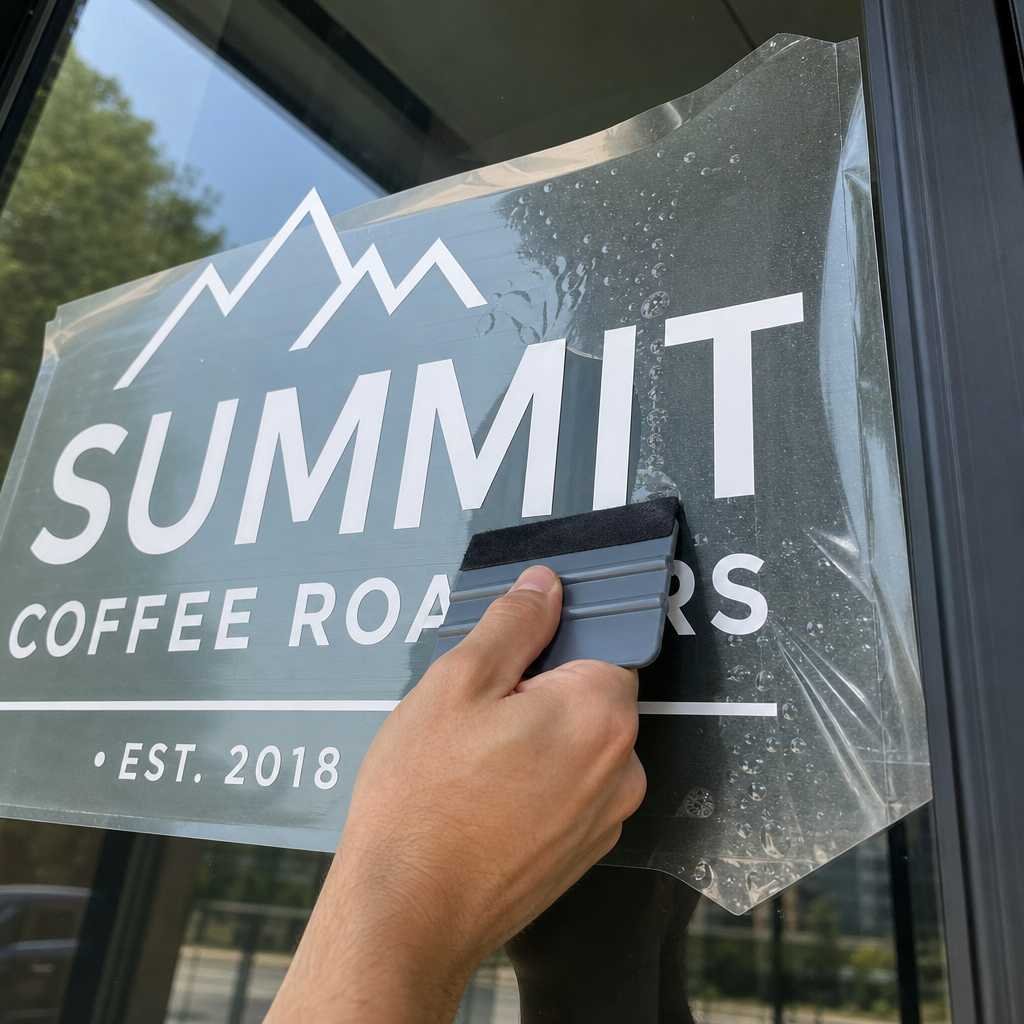
A crooked storefront decal or a bubbled window graphic does more damage than no sign at all. Customers notice sloppy installation before they notice your hours, your logo, or your brand. Learning how to install vinyl lettering decal correctly the first time saves you money, protects your ORACAL® 651 vinyl, and keeps your storefront looking sharp season after season. This guide walks you through every step, from surface prep to final squeegee pass, written specifically for business owners putting professional signage on real glass, not hobbyists sticking decals on laptops.
Table of Contents
- Quick Takeaways
- Tools You Need Before You Start
- Surface Preparation: The Step Most Business Owners Skip
- Positioning and Measuring Your Decal
- Step-by-Step Installation Process
- Wet vs. Dry Application: Comparison
- Post-Installation Finishing and Common Fixes
- Frequently Asked Questions
- References
Quick Takeaways
| Key Insight | Explanation |
|---|---|
| Temperature affects adhesion critically | Install vinyl decals when the glass surface is between 50°F and 90°F. Cold glass prevents adhesive bonding; hot glass causes premature tack and air bubbles. |
| Surface cleanliness is non-negotiable | Even invisible residue from window cleaner sprays leaves a film that prevents ORACAL® 651 vinyl from bonding properly. Use isopropyl alcohol at 70% concentration or higher. |
| Transfer tape is the key to alignment | ORACAL® 651 decals come with a transfer tape layer that keeps multi-letter designs in perfect alignment during application. Never peel it off before placing the decal. |
| Hinge method prevents crooked placement | Tape one edge of the decal to the glass as a hinge point before committing to final placement. This lets you reposition without guesswork. |
| Squeegee direction matters for bubble prevention | Always squeegee from the center outward in firm, overlapping strokes. Side-to-side random pressing traps air instead of releasing it. |
| Transfer tape removal speed affects quality | Peel transfer tape back at a 180-degree angle, slowly and parallel to the glass surface. Pulling upward at 90 degrees lifts vinyl letters off the window. |
| 24-hour cure window before cleaning | ORACAL® 651 vinyl needs at least 24 hours to fully cure to glass before any cleaning or moisture exposure. Premature washing lifts edges. |
Tools You Need Before You Start

Professional results come from professional preparation. Showing up at your storefront window with just the decal and your fingers is a recipe for a botched installation. These are the tools that make the difference between a clean, lasting result and a job you redo in three weeks.
You need a hard plastic squeegee (not a soft rubber one), isopropyl alcohol at 70% concentration or higher, a clean lint-free microfiber cloth, a measuring tape, a level, blue painter’s tape, and a soft pencil or chalk marker for marking placement guides on the glass. If you are doing a wet application, you also need a spray bottle filled with a diluted soapy water solution using a tiny drop of dish soap, not a full squirt.
A common mistake is using paper towels during surface prep. Paper towels leave micro-fiber debris on glass that creates tiny bumps under vinyl. Microfiber cloths only.
Surface Preparation: The Step Most Business Owners Skip
Surface preparation is where most storefront decal installations fail, not during the actual application. Business owners want to get to the visible part, placing the decal, and they treat the prep step as a quick wipe-down. That is the wrong approach entirely.
Why Commercial Glass Surfaces Need Special Attention
Storefront windows collect invisible contamination fast. Traffic exhaust, cooking oils from nearby restaurants, cleaning product residue left by janitorial staff, and finger smudges all create a barrier between your decal’s adhesive and the glass. Standard window cleaners containing ammonia, which means most blue spray cleaners, leave a film that actively repels vinyl adhesive.
The correct process starts with a plain water rinse to remove loose particles, followed by a thorough wipe using isopropyl alcohol on a clean microfiber cloth. Work in sections roughly 18 inches wide and let the alcohol fully evaporate before touching that area again. Do not breathe on the glass after cleaning. The moisture and oils from your breath re-contaminate the surface instantly.
Temperature and Timing Checks
Check the glass surface temperature, not just the air temperature. Glass in direct sunlight on a 65°F day can easily reach 110°F or higher. Touch the glass with your palm. If it is uncomfortable to hold your hand flat against it for 5 seconds, it is too hot for installation. Either wait until the window is in shade or schedule the installation for early morning before direct sun hits the storefront face.
Installation below 50°F is equally problematic. Cold glass causes the vinyl adhesive to stiffen before it can bond, leading to lifting edges within days.
Pro tip: If your storefront window faces west and you are in a warm climate, plan your installation for morning hours when the glass is shaded and cooler. A 7 AM installation on the west-facing glass outperforms a noon attempt every single time.
Positioning and Measuring Your Decal
Measuring is not optional and it is not something you eyeball. A misaligned business hours decal or vinyl lettering sign communicates carelessness to every customer walking past, even if they cannot articulate why your storefront feels slightly off.
Finding the Right Placement Zone
For storefront window decals, eye level for an adult standing at the door is the standard placement zone. This means the center of your decal should sit between 58 and 66 inches from the ground, measured from the exterior sidewalk, not from inside the store. This range accounts for the fact that customers approach from the outside and their natural sightline is forward, not downward.
Use your measuring tape to find the horizontal center of the window or the specific panel where the decal will go. Mark this center point lightly with a chalk marker. Then measure up from the ground to your target height and mark that point too. These two marks are your anchor points for the hinge method you will use during installation.
Using Blue Tape as a Placement Guide
Run a strip of blue painter’s tape horizontally across the window at the height where the bottom of your decal will sit. Use your level to confirm this tape line is perfectly horizontal. Store windows look level to the naked eye but rarely are. An unchecked installation often ends up visibly crooked within 24 hours as your eye adjusts to living with it.
Place your decal face-down against the window at this tape line, then hinge it by running a second piece of painter’s tape along the top edge. This hinge holds the decal in the correct position while you prepare for the actual application step.

Step-by-Step Installation Process
This is the process that works for ORACAL® 651 vinyl lettering decals on commercial glass surfaces. It uses the dry application method, which is the right method for most storefront decal installations because ORACAL® 651 has a permanent adhesive that performs best without moisture interference. The wet method has specific use cases covered in the comparison table below.
Step 1: Pre-Stick the Transfer Tape
Before doing anything with the glass, lay your decal face-up on a flat clean surface. Run your squeegee firmly across the entire transfer tape surface to ensure the transfer tape has fully grabbed every letter and element of the design. Press with real pressure. This step is often skipped, but it prevents individual letters from staying stuck to the backing paper when you try to apply them to the window.
Step 2: Peel the Backing Paper
Hold the decal by the transfer tape layer. Slowly peel the white or yellow backing paper away from the decal, not the other way around. Bend the backing paper back on itself at a sharp angle while holding the transfer tape layer flat. This technique keeps the vinyl letters attached to the transfer tape instead of staying stuck to the backing.
If any letters stay behind on the backing paper, lay it flat, re-press those letters with your squeegee, and try again. Do not force them free with your fingers.
Step 3: Hinge and Apply
With your hinge tape holding the top edge of the decal to the glass, fold the bottom half of the decal away from the window so the adhesive side faces outward. Starting at the hinge line, slowly lower the adhesive side of the decal onto the glass while pressing with your squeegee from the center outward in firm overlapping strokes. Work your way down the decal, releasing it section by section rather than dropping the whole thing at once.
Step 4: Full Squeegee Pass
Once the entire decal is against the glass, do a complete squeegee pass across the whole surface using firm, even pressure. Start at the center of the decal and work outward toward every edge. Repeat this pass at least three times. The goal is to press every millimeter of vinyl into firm contact with the glass and push all trapped air toward the edges where it can escape.
Step 5: Remove Transfer Tape
Wait at least 2 minutes after your final squeegee pass before removing the transfer tape. Then peel the transfer tape back slowly, keeping it parallel to the glass surface at a 180-degree angle. If any letter starts to lift off the glass and come with the transfer tape, stop, press that section back down with your squeegee, wait another 2 minutes, and try again.
Pro tip: On cold days, warm the transfer tape very briefly with a hair dryer on low heat before peeling. This softens the tape’s adhesive and releases the vinyl letters more cleanly, reducing the chance of letters lifting off the glass during tape removal.
Wet vs. Dry Application: Comparison
Not every installation situation is identical. The choice between wet and dry application depends on your decal size, vinyl type, and how much adjustment time you need. Here is how the two approaches compare for storefront window decals made with professional-grade vinyl.
| Factor | Dry Application | Wet Application |
|---|---|---|
| Best for decal size | Small to medium decals under 24 inches wide | Large format decals over 24 inches wide where repositioning is needed |
| Vinyl type compatibility | Ideal for ORACAL® 651 permanent adhesive vinyl | Better suited for repositionable or less aggressive adhesive vinyls |
| Repositioning ability | Very limited, once down it bonds fast | Allows sliding and repositioning for up to 60 seconds after placement |
| Cure time before use | 24 hours standard | 48 to 72 hours required to allow moisture to fully evaporate |
| Risk of bubbles | Low when squeegee technique is correct | Higher risk if moisture is not fully evacuated before cure |
| Skill level required | Moderate, hinge method controls placement | Lower initial skill needed but longer waiting period for full bond |
“Permanent adhesive vinyl like ORACAL® 651 is engineered for outdoor durability and UV resistance, but it bonds aggressively on contact with clean glass. The dry method with a hinge is the professional’s choice for precision placement on storefront windows.” – ORACAL Product Technical Documentation, Tesa SE Group
Post-Installation Finishing and Common Fixes
The job is not done when the transfer tape comes off. The first 24 hours after installation determine whether your storefront decal stays perfectly bonded for years or starts peeling at the edges within weeks.
What to Do in the First 24 Hours
Do not clean the window. Do not spray anything near the decal. If rain is expected, that is acceptable because rain does not penetrate a properly installed decal, but active pressure washing or direct hose spray within the first 24 hours can lift edges before the adhesive has fully cured. Post a note internally for your cleaning staff if they regularly wash the storefront windows.
Inspect the decal from the outside after installation, not from inside the store. Walk to the opposite side of the street and look at the full storefront face. Minor alignment issues that are invisible up close become clear from 20 feet away. If you notice a problem, you have a short window, usually under 30 minutes with ORACAL® 651, to carefully lift and reposition before the adhesive fully commits.
Fixing Small Air Bubbles After Installation
Small air bubbles that appear after transfer tape removal usually resolve on their own within 24 to 72 hours as the adhesive fully grabs the glass. For persistent bubbles, use a sharp pin to make a tiny puncture at the edge of the bubble, then press the air out gently with your fingertip from bubble center to puncture point. Do not use a squeegee for this step. Fingertip pressure is precise enough and avoids scratching the vinyl surface.
Avoiding Edge Lifting Over Time
Edge lifting months after installation usually traces back to one of three causes: surface contamination that was not fully removed during prep, installation in temperatures outside the recommended range, or a window that has a heavy texture or coating from previous commercial films. If you are installing over a window that had film applied before, remove all adhesive residue from the previous film using a commercial adhesive remover before starting your prep process.
Frequently Asked Questions
Can I install a vinyl lettering decal on the inside of the window facing out?
Yes, and for many retail applications this is actually the preferred approach. Interior-mounted decals are protected from weather, UV degradation is reduced, and customers read them through the glass from outside. The installation process is identical, but make sure the decal is designed as a mirror image if it contains readable text, so it reads correctly from the exterior. ORACAL® 651 vinyl works on interior glass surfaces the same way it works on exterior surfaces.
How long does a properly installed ORACAL® 651 decal last on a storefront window?
ORACAL® 651 carries a manufacturer rating of 6 years for outdoor vertical applications, which includes storefront windows. In practice, properly installed decals on clean glass in moderate climates regularly exceed this rating. Decals in high-UV regions like the American Southwest or coastal environments with salt air may show fading closer to the 4 to 5 year mark. Proper installation directly impacts longevity because a decal with lifted edges allows moisture intrusion that accelerates failure.
What is the best way to remove a vinyl decal from a store window without damaging the glass?
Heat is your primary tool. Use a hair dryer or heat gun on a low setting, holding it 3 to 4 inches from the surface, and warm a corner of the decal until it becomes pliable. Gently lift the warmed corner and peel slowly, keeping the angle low and parallel to the glass. Move the heat source along with your peel as you go. Remove any remaining adhesive residue with a commercial adhesive remover or isopropyl alcohol and a plastic scraper. Never use metal blades on glass.
Why is my vinyl lettering decal lifting at the corners within a few weeks of installation?
Corner lifting this soon after installation almost always points to surface contamination during prep. Ammonia-based window cleaners, silicone-based cleaning products, or residue from previous films all prevent proper adhesion. The second most common cause is installation in temperatures below 50°F, which prevents the adhesive from activating fully. If you are seeing consistent edge lifting, clean the remaining edge with isopropyl alcohol, press firmly with a squeegee, and apply an edge sealer available at sign supply stores.
Do I need professional help to install a business hours decal or vinyl lettering sign?
For decals under 24 inches wide, a careful business owner following the steps in this guide can achieve professional results without hiring anyone. Larger format installations, anything over 36 inches, or installations on curved or textured surfaces genuinely benefit from a second pair of hands, not necessarily a professional installer. The hinge method described above handles the alignment challenge that trips up most first-time installers. The tools required cost under 15 dollars total, and the skill ceiling for a standard storefront decal is lower than most business owners assume.
Can vinyl lettering decals go on frosted or tinted windows?
Yes, ORACAL® 651 adheres to frosted, tinted, and tempered glass surfaces. Frosted glass requires extra care during prep because the textured surface traps more contamination than smooth glass. Use more isopropyl alcohol and a slightly stiffer microfiber cloth to work cleaner into the texture. On dark-tinted windows, light-colored or white vinyl lettering provides the best visibility. Avoid glossy vinyl on heavily frosted surfaces because the texture prevents full adhesive contact and increases the risk of early lifting.
If you have installed a vinyl lettering decal on your storefront and ran into a specific challenge this guide did not cover, share what happened and what fixed it so other business owners can benefit from your experience.
We would love your feedback and any insights you would share with others. What perspective would you add?
References
- Forbes Business coverage on small business signage and retail presentation strategies
- Statista data on small business retail and storefront consumer behavior statistics
- U.S. Small Business Administration guidance on retail business operations and physical presence
- HubSpot research on customer experience and first impressions in retail environments
- Penn State Extension research on adhesive material performance and environmental exposure factors