
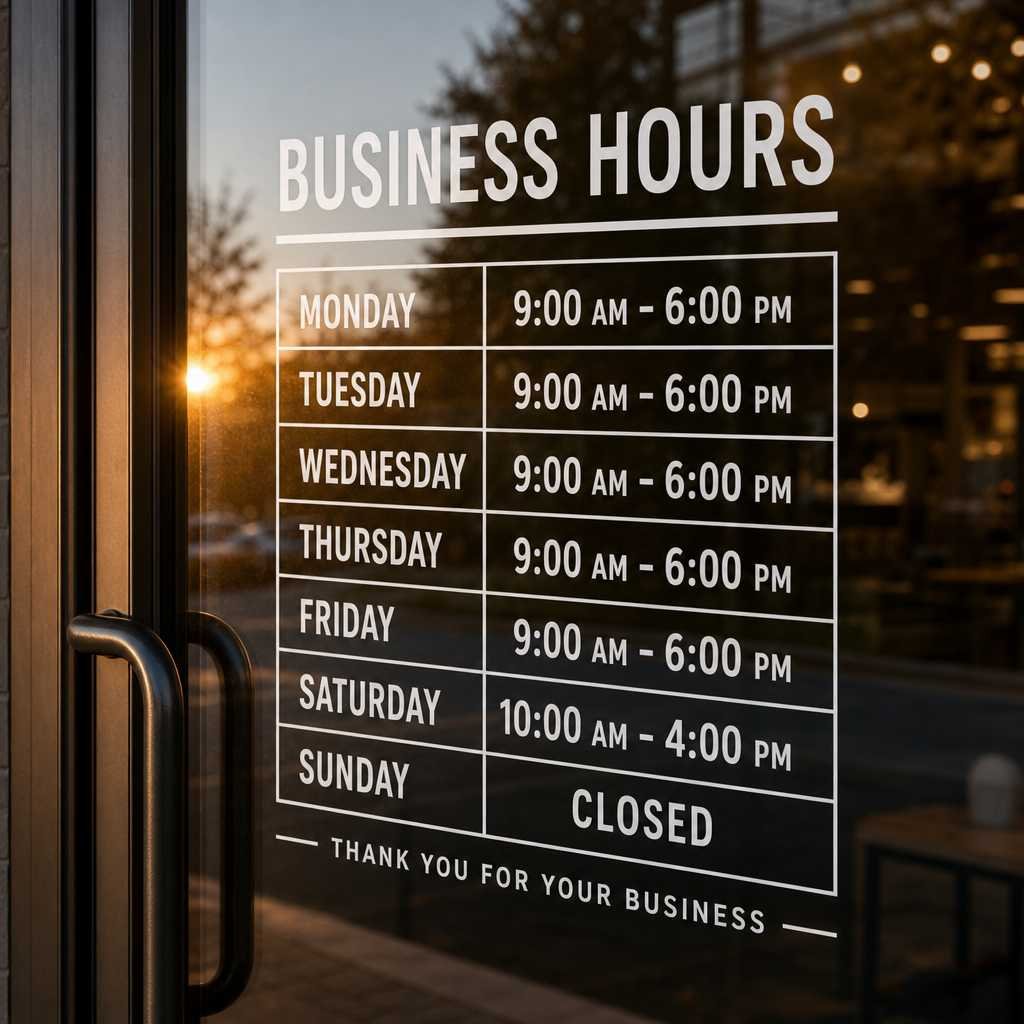
A missing or illegible business hours decal costs you more than you think. Studies on consumer behavior consistently show that unclear store hours are among the top three reasons a potential customer walks away without entering. Yet most retailers treat their hours signage as an afterthought, slapping on a generic label that fades within a season. This guide covers everything a store owner needs to know to design a custom hours decal that communicates clearly, survives the elements, and looks professional enough to build trust before a customer ever opens your door.
Table of Contents
- Quick Takeaways
- Why Your Hours Decal Matters More Than You Think
- Choosing the Right Vinyl Material
- Design Principles for Maximum Readability
- Layout and Format Options
- Color Contrast and Font Selection
- Placement and Installation Best Practices
- Comparing Your Options: DIY vs. Generic vs. Custom Professional
- Frequently Asked Questions
- References
Quick Takeaways
| Key Insight | Explanation |
|---|---|
| Material grade determines lifespan | ORACAL 651 calendered vinyl lasts 6 or more years outdoors versus generic vinyl that fades within 12 to 18 months. |
| Font size drives readability from a distance | Hours text should be a minimum of 1 inch tall for every 10 feet of viewing distance. Most storefronts need at least 2-inch characters. |
| Contrast ratio is non-negotiable | A minimum 4.5:1 contrast ratio between text and background ensures legibility in both bright sunlight and low evening light. |
| Placement on glass beats placement on walls | Rear glass and front door decals are read 3 to 4 times more frequently than wall-mounted signs because they sit at natural eye level. |
| Include all operational days explicitly | Listing only open days creates confusion. Stating “Closed Sunday” eliminates wasted trips and reduces negative reviews tied to misinformation. |
| Weatherproof and UV-resistant are not the same thing | Weatherproof means water resistance. UV-resistant means the color will not fade. You need both properties for an outdoor-facing store hours sign. |
| Custom sizing outperforms off-the-shelf templates | A decal sized to your specific door or window panel looks intentional and professional, while a mismatched generic sticker signals low effort to customers. |
Why Your Hours Decal Matters More Than You Think

Your store hours sign is often the first piece of communication a potential customer reads before deciding whether to enter. It is not decorative. It is functional trust-building signage that answers a binary question: are you open right now, and should I come back if you are not?
According to a Local Consumer Review Survey by BrightLocal, 76% of consumers search for business hours before visiting a local store. When those hours are absent, wrong, or hard to read on your physical location, the mismatch between online information and in-person reality generates friction that kills conversions and fuels negative reviews.
A common mistake is treating the business hours decal as a single-purpose label. In practice, a well-designed shop hours sticker reinforces your brand identity through consistent fonts and color choices, communicates operational professionalism, and reduces the volume of phone calls asking “are you open on Sundays?” That last point alone saves measurable staff time over a year.
Pro tip: Add your phone number in small text directly below your hours block. Customers who arrive when you are closed will call instead of leaving permanently, and that small addition costs nothing on a custom decal order.
Choosing the Right Vinyl Material
Not all vinyl is the same, and the material choice determines whether your custom hours decal looks sharp after five years or peels and fades within one winter. The two most relevant categories for storefront use are calendered vinyl and cast vinyl, with ORACAL 651 being the professional standard for permanent outdoor decals.
ORACAL 651 vs. Generic Vinyl
ORACAL 651 is a calendered intermediate vinyl rated for six or more years of outdoor use. It is UV-stabilized, waterproof, and has a permanent adhesive that bonds cleanly to glass, painted metal, and smooth plastic surfaces. Generic vinyl products found at big-box office supply stores are typically rated for 12 to 18 months and use lower-quality inks that shift color under direct sun exposure.
For a store hours sign applied to a south-facing glass door or window, the UV rating is critical. A decal that turns yellow or loses contrast within a year looks unprofessional and requires replacement, which costs more in labor and disruption than buying quality material upfront.
Surface Compatibility
ORACAL 651 adheres to flat and slightly curved smooth surfaces. It works on glass doors, smooth metal door frames, acrylic panels, and vehicle windows. It does not perform well on brick, textured stucco, or heavily irregular surfaces. If your storefront has those surfaces, a framed sign holder with an inserted printed panel is a better choice than a direct-adhesive decal.
Rear glass decals and front door applications are the highest-traffic use cases for a shop hours sticker, and flat glass is the ideal surface for ORACAL 651 adhesion and longevity.
Pro tip: Always clean the application surface with isopropyl alcohol before installing any vinyl decal. Residual oils from fingerprints or cleaning products are the number one cause of premature edge lifting, even on premium vinyl.
Design Principles for Maximum Readability
Readability is not a matter of personal taste. It follows specific rules tied to viewing distance, ambient lighting, and human visual processing. A store hours sign that looks attractive in a design preview but fails under real-world conditions is a wasted investment.
The One-Inch-Per-Ten-Feet Rule
The standard signage readability formula states that text needs to be 1 inch tall for every 10 feet of intended reading distance. For a storefront where customers approach from across a parking lot at roughly 30 feet, your hours text should be at least 3 inches tall. For a door decal read at arm’s length, 1 inch is acceptable for secondary text, but the primary hours block should still be 1.5 to 2 inches for easy scanning.
Most generic off-the-shelf store hours labels use 0.5-inch text, which is optimized for reading at 5 feet. That assumes customers are already at your door. A better-designed decal communicates your hours from a distance, pulling hesitant customers toward your entrance.
Information Hierarchy
Your hours decal should present information in this priority order: business name or “HOURS” header at the top, then the day groupings, then the times, then any closed days explicitly noted. Do not bury closed days in fine print. Customers who make a wasted trip because Sunday closures were unclear will not give you a second chance.
Keep the layout scannable. Group weekday hours together, separate weekend hours visually, and use a slightly larger or bolder font for any day with different hours, such as a Saturday closing time that differs from Monday through Friday.
Layout and Format Options
There are three standard layout formats for a business hours decal: the stacked list, the grid table, and the compact inline format. Each serves a different storefront situation.
Stacked List Format
The stacked list is the most common format. Each row contains a day or day range on the left and hours on the right, separated by a line or consistent spacing. This format works well for full-height door decals where vertical space is available. It is the easiest to read at a glance and the most forgiving when your hours vary significantly across the week.
Grid Table Format
The grid table uses a two or three column structure to compress the same information into a smaller footprint. It suits businesses with consistent hours across most days, where the table structure makes the repetition obvious. A coffee shop open 7am to 7pm Monday through Saturday with Sunday closures reads faster in a compact grid than in a seven-row stacked list.
Compact Inline Format
The inline format fits hours into a single block of text, such as “Mon-Fri 9am-6pm, Sat 10am-4pm, Closed Sun.” This format works only for small decals applied in tight spaces, such as a window corner or car door. It sacrifices scannability for compactness. Use it only as a secondary hours reference, not as your primary store hours sign.

Color Contrast and Font Selection
Color and font choices are where most DIY decal designs fail. The combination of low contrast and decorative fonts makes otherwise accurate information unreadable in real-world storefront conditions.
Contrast Ratios That Work Outdoors
The Web Content Accessibility Guidelines (WCAG) require a 4.5:1 contrast ratio for readable text. This standard applies equally to physical signage. In practice, the highest-contrast combinations are black on white, white on dark navy, and white on dark green. Avoid gray-on-white, yellow-on-white, and any pastel pairing. Under direct afternoon sunlight, low-contrast color combinations become effectively invisible.
For vinyl decals specifically, dark cut vinyl letters on a clear or white background consistently outperform full-color printed decals in outdoor readability tests. If you need color branding, apply it to a border or header block rather than the hours text itself.
Font Selection for Storefront Decals
Use sans-serif fonts for maximum legibility. Helvetica, Arial, Futura, and Montserrat all perform well at small sizes and from a distance. Script and decorative fonts should be reserved for business name headers only, never for the hours data itself. A common mistake is using a decorative font for the entire decal because it matches the brand aesthetic. That choice consistently reduces how quickly and accurately customers absorb the hours information.
“Legibility is the foundation of all effective signage. A sign that cannot be read at its intended viewing distance has failed its primary job, regardless of how attractive it looks in a proof.” – Sign Research Foundation, Signage and Wayfinding Best Practices
Letter spacing matters too. Tight tracking on condensed fonts at small sizes causes letters to merge visually at distance. Add 5 to 10% letter spacing to any font used at 1 inch or smaller to maintain clean separation between characters.
Placement and Installation Best Practices
A perfectly designed custom hours decal installed in the wrong location is still a poor investment. Placement determines whether your signage actually gets seen and read at the moment customers need the information.
Primary Placement: Front Door Glass
The front door glass panel is the single best location for a business hours decal. It is at eye level, faces approaching customers directly, and is read at the exact moment a decision is being made about whether to enter. Position the decal on the pull side of the door at approximately 58 to 62 inches from the ground, which sits within the standard adult eye-level range.
Secondary Placement: Adjacent Window Panel
If your front door is solid or has limited glass area, the fixed window panel immediately adjacent to the door is the next best option. Customers naturally scan this area when approaching. Avoid placing hours signage on windows that are more than 6 feet from the door handle, as the spatial connection between the sign and the entry point weakens at that distance.
Installation Technique
Clean the surface with isopropyl alcohol. Allow the surface to dry fully, at least 10 minutes. For decals larger than 6 by 12 inches, use the hinge method: tape the top edge of the decal in place, fold the decal back, remove the backing liner from half the decal, press that half down, then remove the remaining liner and press the rest. Use a squeegee or a credit card wrapped in a soft cloth to push out air bubbles from center to edges. Wait 24 hours before exposing the decal to water or cleaning products.
Pro tip: Apply vinyl decals when the surface temperature is between 50 and 90 degrees Fahrenheit. Adhesive performance drops sharply below 50 degrees, causing poor initial bond strength that leads to premature peeling regardless of material quality.
Comparing Your Options: DIY vs. Generic vs. Custom Professional
Store owners considering a shop hours sticker typically evaluate three sourcing approaches. The table below compares them honestly across the factors that matter most for a permanent storefront application.
| Option | Strengths | Weaknesses |
|---|---|---|
| DIY Cut Vinyl (home cutter like Cricut) | Low per-unit cost, flexible timing, unlimited revisions | Consumer-grade vinyl lasts 1 to 2 years outdoors, quality ceiling is limited by cutter precision, time-intensive for complex layouts |
| Generic Pre-Made Store Hours Label (office supply or online template site) | Immediate availability, very low upfront cost | No customization, generic appearance, typically uses low-grade vinyl rated under 18 months, no brand integration, sizes rarely match door panels |
| Custom Professional Decal (ORACAL 651, made in USA, fully customized) | 6-plus year outdoor lifespan, exact sizing for your surface, brand-consistent fonts and colors, UV-resistant and weatherproof, professional finish | Higher upfront cost than generic labels, requires lead time for production |
The data consistently shows that businesses using professional-grade custom decals replace their hours signage far less frequently than those using generic labels. Over a five-year period, the total cost of ownership for a quality custom business hours decal is typically lower than replacing a generic label three or four times during the same window.
Competitors like generic decal marketplaces and bulk sticker printers offer low per-unit pricing but routinely use short-life films that are not suited for permanent outdoor storefront applications. When comparing options, always ask for the outdoor durability rating in years and whether the product is UV-resistant, not just waterproof.
Frequently Asked Questions
What size should a business hours decal be for a standard front door?
For a standard 36-inch wide front door, a decal between 8 and 12 inches wide and 10 and 16 inches tall is the most practical size. This provides enough vertical space for a full seven-day stacked list with readable 1.5 to 2-inch characters while staying proportional to the door panel. Custom sizing to your exact door dimensions always looks more intentional than a generic fixed size.
Can a store hours sign be applied to the outside of a glass door?
Yes. ORACAL 651 vinyl adheres well to exterior glass surfaces. Exterior application means the decal faces direct weather, UV exposure, and physical contact from customers, which makes material quality even more important. For exterior glass, ensure the adhesive is rated for permanent outdoor use and that the inks or vinyl colors are UV-stabilized to prevent fading under direct sun.
How do I update a custom hours decal if my hours change?
The most cost-effective approach is to design your decal with a separate smaller “hours change” strip that can be replaced without removing the entire decal. Some businesses order a full replacement decal when hours change permanently, since professional-grade vinyl removes cleanly from glass without adhesive residue when done correctly. Avoid layering a new decal on top of an old one, as this creates visible edges and thickness inconsistencies.
What is the difference between a shop hours sticker and a static cling?
A shop hours sticker uses pressure-sensitive adhesive to create a permanent or semi-permanent bond with the surface. A static cling uses electrostatic attraction instead of adhesive and can be removed and repositioned without leaving residue. Static clings are suitable for temporary or seasonal hours signage. For permanent storefront use, adhesive vinyl decals are more reliable since static clings can fall off in humid or dusty environments and have a shorter useful life outdoors.
Should I include holiday hours on my business hours decal?
No. A permanent custom hours decal should display only your standard weekly hours. Holiday hours change annually and vary too much to include on permanent signage. Instead, use a separate, smaller temporary decal or printed insert for holiday hour adjustments. This keeps your permanent decal accurate and avoids the confusing situation where outdated holiday hours remain visible long after the holiday has passed.
How long does a professional-grade custom hours decal last outdoors?
ORACAL 651 vinyl, which is the professional standard used by quality decal manufacturers, is rated for six or more years in outdoor conditions including UV exposure, rain, and temperature cycling. In practice, decals applied to glass surfaces in moderate climates often last seven to nine years before any visible edge lifting or color shift occurs. Cheap generic vinyl from template-based online printers typically lasts 12 to 24 months under the same conditions.
Share your own experience with storefront hours signage in the comments. What has worked in your specific location and what has not?
References
- Statista: Consumer behavior statistics and retail survey data used to support signage effectiveness research
- Forbes: Small business operations and retail storefront best practices coverage
- HubSpot Marketing Statistics: Data on consumer decision-making and local business visibility
- U.S. Small Business Administration: Guidance on retail signage compliance, ADA requirements, and storefront standards for small business owners
- Moz: Local SEO and business listing accuracy resources relevant to consistent hours communication across physical and digital channels