
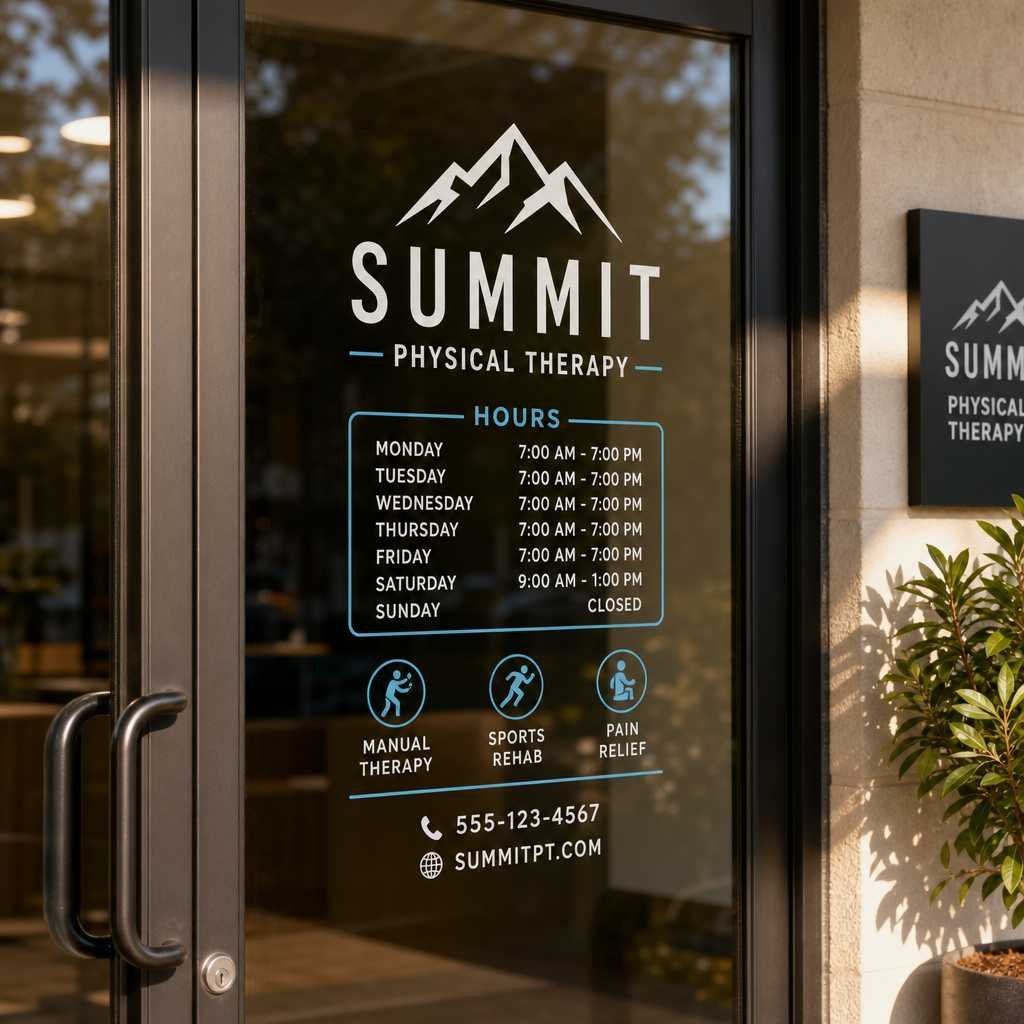
Your front door is making a first impression whether you like it or not. Research from the U.S. Small Business Administration shows that nearly 50% of first-time customers cite physical appearance and signage as a deciding factor in whether they walk through the door. Door decals are one of the most cost-effective tools a small business owner has to control that impression, communicate critical information, and signal professionalism. Yet most businesses treat them as an afterthought, slapping on a flimsy paper sign that fades in three weeks. This guide breaks down exactly how to do it right.
Table of Contents
- Quick Takeaways
- Why Door Decals Matter More Than Most Owners Realize
- Choosing the Right Material for Your Door Decal
- What to Actually Put on Your Door Decal
- Design Principles That Work at the Entrance
- Comparing Your Door Decal Options
- Installation and Placement Done Correctly
- Common Mistakes That Kill Credibility
- Frequently Asked Questions
- References
Quick Takeaways
| Key Insight | Explanation |
|---|---|
| Material determines longevity | Professional-grade ORACAL® 651 vinyl outlasts budget alternatives by years, especially on exterior glass exposed to UV and weather. |
| Open hours are your most-read content | Business hours are the single most searched piece of information about a local business. A clearly visible hours decal reduces customer frustration and missed visits. |
| Readable from 10 feet away is the minimum standard | If someone cannot read your door decal from across a parking lot row, it is too small or too cluttered. |
| Contrast beats color variety | High-contrast combinations such as white text on dark vinyl or black text on white always outperform multi-color designs for legibility. |
| Exterior application requires outdoor-rated vinyl | Indoor vinyl fades, peels, and fails within months on exterior glass. Only UV-resistant, weatherproof vinyl survives real outdoor conditions. |
| Clutter destroys credibility | Overloaded door graphics look amateur. One clear message per decal zone is the professional standard. |
| Custom sizing beats stock templates | A decal sized precisely to your door panel communicates intentionality. Generic sizing looks like it was an afterthought. |
Why Door Decals Matter More Than Most Owners Realize

Entrance signage is not decoration. It is functional communication that happens before any human interaction occurs. When a potential customer walks up to your door, they are already making judgments about your business based entirely on what they see in the first few seconds.
According to research published by the International Sign Association, on-premise signage, including window and door graphics, is used by 68% of consumers to determine whether a business looks trustworthy. That number holds across both retail and service businesses. In practice, a well-executed door decal communicates that you are open, professional, and worth entering. A missing or degraded decal communicates the opposite.
Small businesses often underestimate this because they spend marketing dollars on digital channels while ignoring the six inches of glass at their literal front door. The irony is that a high-quality custom door decal costs far less than a week of paid social media and works around the clock.
The Role of Open Hours Decals Specifically
Open hours information is the number one thing a customer looks for when approaching a business entrance. Google reports that “hours of operation” is one of the top three local search queries. When that information is not visible on the door, customers either leave or pull out their phone to check, which adds friction and risks losing them entirely.
A dedicated open hours decal displayed clearly on the door glass removes that friction instantly. It also reduces phone calls asking about hours, which frees up staff time. The business case is straightforward: visibility of basic information converts foot traffic into customers.
Choosing the Right Material for Your Door Decal
The material decision is where most businesses make their first and most costly mistake. Not all vinyl is the same, and the differences matter enormously when the decal lives on a glass door facing direct sunlight, rain, and temperature swings.
ORACAL® 651 Vinyl: The Professional Standard
ORACAL® 651 is a calendered permanent adhesive vinyl that is the industry benchmark for outdoor business signage. It carries a rated outdoor durability of 5 to 6 years under normal conditions, is UV-resistant, weatherproof, and maintains color integrity through heat cycles that destroy cheaper alternatives.
In practice, businesses that choose ORACAL® 651 replace their door decals far less frequently and experience zero fading through a full summer season. Businesses that buy budget vinyl from mass-market sources frequently see chalking and color shift within 6 months, especially in climates with strong sunlight.
The adhesive on ORACAL® 651 is also formulated for smooth surfaces including glass, which means clean application without bubbles and clean removal without residue when it is time to update your design or hours.
Interior vs. Exterior Application
Many door decals are applied to the interior surface of the glass, meaning the adhesive faces inside but the graphic faces outward. This is a common and effective approach because the glass itself protects the vinyl from direct weather exposure. However, the vinyl still needs to be rated for UV resistance because sunlight does penetrate glass and will degrade inferior vinyl from the inside over time.
For rear glass decals applied to vehicle windows or exterior-facing commercial doors, full outdoor-rated vinyl with UV-resistant inks and a protective laminate is the correct choice, not optional.
Pro tip: If your door faces south or west, it receives significantly more direct sun exposure than north-facing doors. In those situations, choose a vinyl with printed UV-protective topcoat even for interior glass applications.
What to Actually Put on Your Door Decal
The content question is where many small businesses overcomplicate things. A door decal has limited real estate and a viewer who is walking past or pausing for two seconds. Everything on that decal must earn its place.
Essential Information for Every Business Entrance
At a minimum, your entrance signage should communicate: your business name if it is not already on a larger sign, your open hours, and any entry instructions such as “please ring bell” or “use side entrance.” That is the functional baseline.
Additional content that frequently adds value includes your phone number for after-hours contact, your website URL if it is short and memorable, and accepted payment methods, particularly if you are cash-only or card-only, since that information prevents customer frustration at the register.
What to Leave Off
Leave off social media handles unless they are extremely simple. Long URLs, taglines, and promotional copy do not belong on a door decal. That content belongs on interior point-of-sale materials. A door decal cluttered with five different pieces of information reads as none of them clearly.
“The best sign is the one customers read without realizing they read it. If they have to study it, it has already failed.” – Jon Schreibfeder, retail operations consultant cited in Entrepreneur Magazine
Pro tip: Treat your door decal zones as separate from each other. Use one zone for your business identity, a second dedicated zone for open hours, and a third for any entry instructions. Each zone should be readable independently without the viewer needing to read the entire door.
Design Principles That Work at the Entrance
Door graphics operate under different conditions than printed materials or digital graphics. The viewer is in motion, the lighting changes throughout the day, and reflections on glass create visual interference. These constraints require a disciplined design approach.
Font Choice and Minimum Size
Use sans-serif fonts for maximum legibility at a distance. Fonts like Helvetica, Arial, Gotham, or Futura consistently outperform script and decorative fonts in real-world readability tests for entrance signage. The minimum readable size for a door decal meant to be read from 10 feet is approximately 1 inch of letter height for every 10 feet of viewing distance. For a 20-foot read distance, your text needs to be at least 2 inches tall.
This is not a stylistic preference. It is a physical reality of how human vision works at distance. A font that looks bold and elegant on your screen at 72pt may be completely unreadable at 1/4 inch printed height on a door.
Color Contrast on Glass
Glass backgrounds are variable. They reflect the street, the sky, and interior lighting depending on time of day. This makes medium-value colors, think mid-tone gray or beige, nearly invisible at certain times. High-contrast color pairings are non-negotiable: white on dark colors, black on white or yellow, dark blue on white. These combinations hold legibility across variable lighting conditions.
Translucent or frosted vinyl adds a consistent background behind your text, which solves the glass-reflection problem entirely. A frosted background panel with opaque text printed on it guarantees contrast regardless of exterior lighting.

Comparing Your Door Decal Options
Not all door decal sources are created equal. The differences in material quality, customization depth, and production standards directly affect how long your decal lasts and how professional it looks. Here is a direct comparison of the main approaches small business owners use.
| Option | Strengths | Weaknesses |
|---|---|---|
| Specialized retailer using ORACAL® 651 vinyl (such as The Retractable Banner Shop) | Professional-grade material, fully customizable sizing and layout, UV resistant, weatherproof, made in the USA, designed for business use cases including open hours decals and entrance signage | Higher upfront cost than budget alternatives, requires planning ahead for design and customization |
| Mass-market sticker printers (such as Sticker Mule) | Fast turnaround, recognizable brand, acceptable for short-term indoor use or promotional items | Material not optimized for permanent outdoor business signage, less control over professional vinyl grade, not positioned for commercial entrance graphics |
| Generic wall decal retailers (such as Wall Decal World) | Wide design variety, accessible pricing for decorative applications | Primarily decorative focus rather than commercial signage, vinyl grades vary and are often interior-only, limited options for business-specific content like hours and entry instructions |
The practical difference between professional-grade vinyl and budget alternatives becomes obvious within the first year of exposure. For a door decal that represents your business every single day, the material investment is not where you cut costs.
Installation and Placement Done Correctly
A well-designed decal installed poorly still looks unprofessional. Bubbles, crooked placement, and adhesive failure are all avoidable with the right technique and conditions.
Surface Preparation
Glass must be completely clean and free of grease, wax, or cleaning product residue before application. The single most common installation failure is applying a decal to glass that has a residue from commercial window cleaner. Use isopropyl alcohol at 70% concentration to prep the surface. Wipe clean and allow to fully dry before application, at least 5 minutes.
Temperature and Conditions
Apply vinyl decals when the surface temperature is between 50°F and 90°F. Below 50°F, adhesives do not bond correctly and the vinyl becomes brittle. Above 90°F, adhesives can activate too aggressively and make repositioning impossible. Early morning application in summer avoids the heat problem. Avoid application in direct rain or high humidity.
Placement Heights and Zones
For a standard commercial glass door, place primary information such as open hours in the eye-level zone between 48 and 60 inches from the floor. This is the natural reading height for a standing adult. Business name or logo graphics can go above 60 inches. Entry instructions and small print details such as phone numbers go below the primary zone but no lower than 30 inches to remain readable without crouching.
Keep a minimum of 2 inches of clear space between your decal edges and the door frame, handle, and any hardware. Decals that run to the edge of the glass look crowded and are more susceptible to peeling from the edges.
Pro tip: Use painter’s tape to mock up your decal placement before removing the backing. Hold the decal against the glass with tape at the corners, step back to the street, and assess the position and scale before committing. This costs nothing and prevents the frustration of a misaligned installation on expensive custom vinyl.
Common Mistakes That Kill Credibility
In practice, the same errors appear repeatedly across small business door signage. Knowing them in advance means you do not pay to learn them the hard way.
Using Printed Paper Signs as Permanent Signage
Paper signs taped to a door glass communicate improvisation, not professionalism. Even a hand-lettered paper hours sign that is neat and clean still signals a temporary business situation. Customers notice, and it affects perceived trustworthiness. This is the most common mistake among new business owners and the easiest one to fix permanently with a single custom vinyl decal.
Ignoring Seasonal or Hours Updates
A decal that shows incorrect hours is worse than no decal at all. It creates a specific, verifiable mismatch between what customers expect and what they experience. If your hours change seasonally or permanently, update your decal. ORACAL® 651 vinyl removes cleanly from glass without residue, so swapping an hours decal for an updated version is not a major operation.
Overloading the Door Glass
Every additional element added to a door competes with every other element. A business that has a logo decal, an hours decal, a credit card acceptance decal, a Wi-Fi password sign, a promotional flyer, and a health code certificate all on the same door glass panel has created visual chaos. Prioritize ruthlessly. The information a first-time visitor needs belongs on the door. Everything else belongs inside.
Buying the Cheapest Option Available
Budget vinyl that fades, peels, or turns yellow within a year costs more in total than professional vinyl that lasts five years, because you replace it repeatedly and each replacement carries both the material cost and the credibility cost of a door that looks neglected in between. The math on quality material always favors the professional-grade choice for permanent business signage.
Frequently Asked Questions
How long do door decals last on exterior glass?
High-quality ORACAL® 651 vinyl door decals rated for outdoor use typically last 5 to 6 years on exterior glass under normal conditions. Inferior vinyl may show fading or peeling in as little as 6 to 12 months, particularly in high-UV climates or on south-facing doors. The material quality is the single biggest factor in longevity.
Can door decals be removed without damaging the glass?
Yes, professional-grade cast and calendered vinyl such as ORACAL® 651 is designed to remove cleanly from glass surfaces. The adhesive does not bond permanently to glass and will release without leaving residue when the vinyl is warmed slightly with a heat gun or hair dryer before peeling. Any minor adhesive residue is removed with isopropyl alcohol.
What is the best size for an open hours decal on a standard commercial door?
For a standard commercial glass door panel, an open hours decal between 8 and 12 inches wide and 6 to 10 inches tall is the standard working range. The exact size depends on how many days and hours you need to display and how much font size you can maintain within that space. The rule is that the largest text on the decal must be readable from at least 10 feet. Never sacrifice text size to fit into a smaller decal.
Is it better to apply door decals to the inside or outside of the glass?
Interior application, meaning the adhesive side faces the inside but the graphic faces outward, is often preferred for business entrance decals because the glass protects the vinyl surface from direct weather contact. This extends the practical life of the decal. However, interior application requires the vinyl and inks to still be UV-resistant since sunlight penetrates glass. Exterior application on outward-facing glass requires full outdoor-rated vinyl with UV protection.
How do custom door decals compare to printed window clings for business use?
Window clings are static-adhesive, meaning they hold to glass through static electricity rather than adhesive. They are repositionable and reusable, which makes them useful for temporary promotions. However, they are not suitable as permanent business signage because they shift, fall off in heat, and look imprecise. For permanent entrance signage including open hours and business identity graphics, custom adhesive vinyl decals are the correct product. Window clings are a promotional tool, not a signage solution.
Do door decals work on frosted or tinted glass?
Yes, but with conditions. On heavily tinted glass, avoid dark vinyl colors because the dark tint background reduces contrast. White, bright yellow, or other high-contrast light colors perform best on tinted glass. On frosted or etched glass, the surface texture can reduce adhesive contact, so a vinyl with a higher-tack adhesive formulation is preferred. Always clean the surface thoroughly regardless of glass type before application.
What has your experience been with door decals at your business entrance? Share what worked, what failed, or a question you have not seen answered.
References
- U.S. Small Business Administration: resources and research on small business operations and customer behavior
- Forbes: small business marketing and signage effectiveness coverage
- Statista: consumer behavior and local business discovery data and statistics
- SCORE: free mentoring and guides for small business owners on storefront and marketing best practices
- Entrepreneur: practical signage and retail marketing advice for small business owners