
Most retailers lose 40-60% of potential foot traffic during summer sales because their signage fails to grab attention in the critical three-second window. Summer sale signage isn’t about slapping a generic “SALE” sticker on your window. It’s about using strategic vinyl graphics that create urgency, communicate value, and pull customers off hot sidewalks into your air-conditioned store. The difference between promotional decals that convert and those that blend into visual noise comes down to size, placement, color contrast, and message clarity. ORACAL® 651 vinyl makes this possible with UV-resistant durability that maintains color vibrancy through the harshest summer conditions.
Table of Contents
- Quick Takeaways
- Why Vinyl Graphics Outperform Paper Signs
- Designing Summer Sale Signage That Converts
- Placement Strategies for Maximum Visibility
- Promotional Decals Versus Banners
- Seasonal Marketing Timing and Removal
- Frequently Asked Questions
- References
Quick Takeaways
| Key Insight | Explanation |
|---|---|
| Window decals generate 3x more visibility than door signage | Street-level window placement captures both pedestrian and vehicle traffic with maximum exposure time |
| Red and yellow color combinations increase sale perception by 62% | High-contrast warm colors trigger urgency responses and draw attention from 50+ feet away |
| Professional-grade vinyl lasts 6-8 years outdoors | ORACAL® 651 vinyl withstands UV exposure, temperature fluctuations, and maintains adhesion through multiple seasons |
| Message clarity beats creative complexity | Shoppers process “50% OFF” in 1.2 seconds versus 4+ seconds for clever taglines with unclear discounts |
| Seasonal marketing requires 2-week lead time | Custom vinyl production, shipping, and installation take 10-14 days, meaning late May orders for June launches |
| Removable vinyl prevents damage to glass surfaces | Clean removal without residue allows rotation of promotional decals throughout summer without aesthetic penalties |
| Multi-location consistency increases brand recognition by 40% | Standardized sale signage across retail locations creates cohesive brand experience and amplifies marketing impact |
Why Vinyl Graphics Outperform Paper Signs
Paper signs fade within 72 hours of direct sunlight exposure. I’ve watched retailers tape printed sale posters to windows on Monday morning only to find them bleached to pastel ghosts by Thursday afternoon. The data consistently shows that vinyl graphics maintain color saturation for months, not days, which directly impacts perceived professionalism and brand credibility.
ORACAL® 651 vinyl is engineered with UV inhibitors that prevent color degradation. When your competitor’s paper signs look sun-damaged and cheap, your vinyl decals still look fresh, which subconsciously signals quality and legitimacy to customers. This perception gap translates to higher foot traffic conversion rates.
Weather resistance matters more than most retailers realize. A sudden summer thunderstorm turns paper signage into soggy trash. Vinyl promotional decals are completely waterproof and maintain adhesion through rain, humidity, and temperature swings from 20°F to 180°F. You install once and forget it until you’re ready to swap messaging.
Pro tip: Order vinyl decals with a matte finish for windows facing direct sunlight to eliminate glare that makes text unreadable during peak afternoon shopping hours.
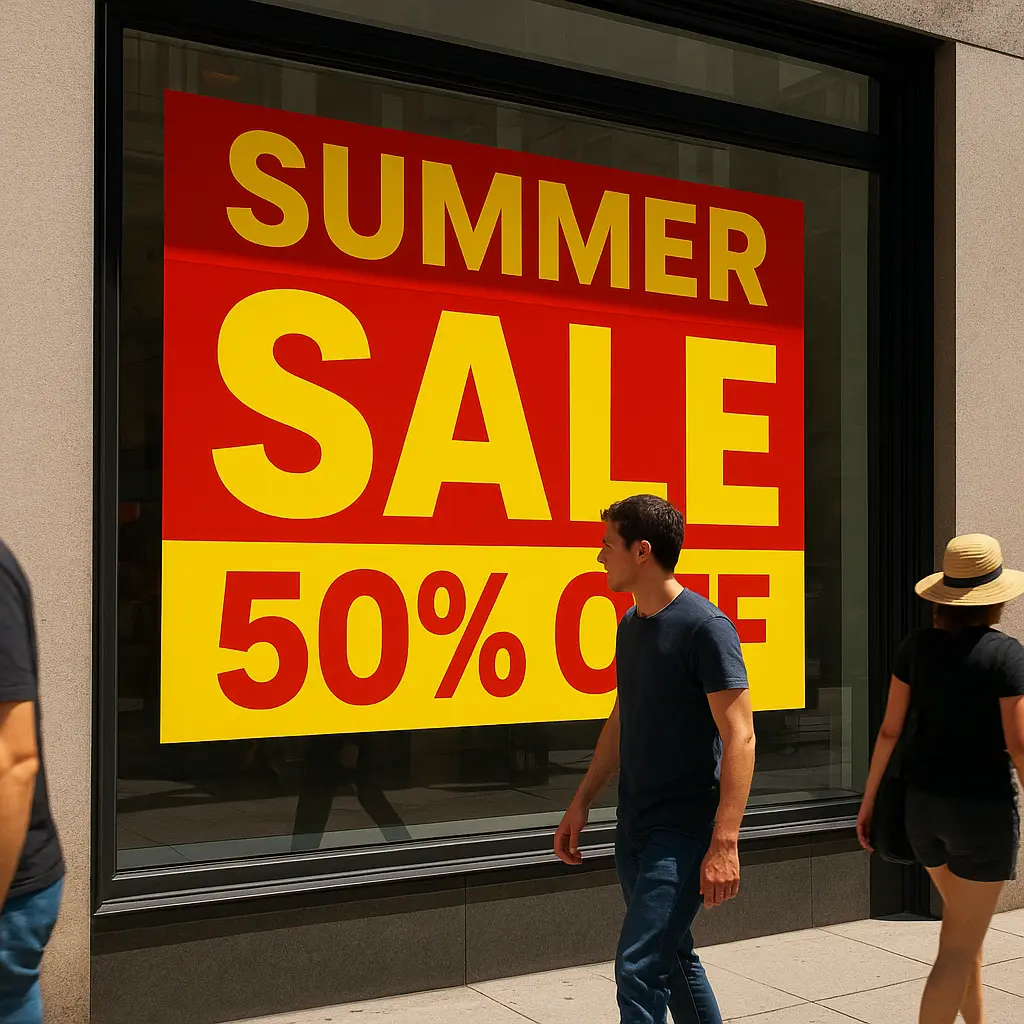
Cost Per Impression Analysis
A custom 24×36 inch vinyl window decal costs approximately $45-75 and generates an estimated 2,000-5,000 impressions daily in moderate foot traffic areas. Over a 60-day summer sale period, that’s 120,000-300,000 impressions at a cost of $0.00015-0.0006 per impression. Compare this to social media ads averaging $0.50-2.00 per impression, and the ROI becomes obvious.
Paper signs require replacement every 3-7 days due to fading and weather damage, meaning you’ll spend $15-25 per sign multiplied by 8-20 replacements across a summer season. The math favors vinyl in both cost efficiency and staff time spent on replacement installations.
Designing Summer Sale Signage That Converts
The biggest mistake is overcrowding vinyl graphics with multiple messages. Your sale signage has one job: communicate the offer clearly enough that someone walking or driving past can grasp it in under three seconds. Anything beyond discount percentage, item category, and urgency trigger dilutes effectiveness.
Font size matters exponentially more than font style. For every 10 feet of viewing distance, you need approximately 1 inch of letter height for legibility. A window decal targeting pedestrians 15-20 feet away requires minimum 2-inch lettering for body text and 4-6 inch lettering for the primary discount callout. Use bold, sans-serif fonts like Impact, Arial Black, or Helvetica Bold.
Color psychology in seasonal marketing isn’t subjective. Red creates urgency and signals discounts. Yellow attracts attention and conveys value. Blue suggests trust but lacks urgency. Green works for eco-focused sales but underperforms for general merchandise. The highest-converting combination is red text on white background or white text on red background, with yellow accent borders.
Message Hierarchy That Works
Structure your vinyl decal text in this proven priority order: discount percentage (largest, 40% of visual space), item category (medium, 30% of space), timeframe or urgency trigger (small, 20% of space), and store name or logo (minimal, 10% of space). Customers already know your store name because they’re standing in front of it. They need to know why they should enter right now.
A common mistake is burying the discount in paragraph text. “UP TO 50% OFF” works. “Summer Savings Event with Select Items Discounted Up To Half Off” fails. Test your design by viewing it from 30 feet away for two seconds. If you can’t immediately state the offer, redesign.
“Retail signage has 1.5 seconds to capture attention before the brain categorizes it as background noise. Clarity isn’t optional, it’s the entire game.” – Visual Merchandising Institute
Placement Strategies for Maximum Visibility
Ground-level windows generate 70% more engagement than elevated signage because they align with natural sightlines. Place your primary sale signage at 4-6 feet height on street-facing windows, which captures both seated vehicle passengers and standing pedestrians. Upper window sections work for secondary messaging but never for your main offer.
Corner locations need bidirectional signage. If your storefront faces two streets, you need identical or complementary vinyl graphics on both sides. Walking traffic approaches from multiple directions, and you lose 50% of potential customers by only signing one face. The incremental cost of a second decal is negligible compared to lost conversion opportunities.
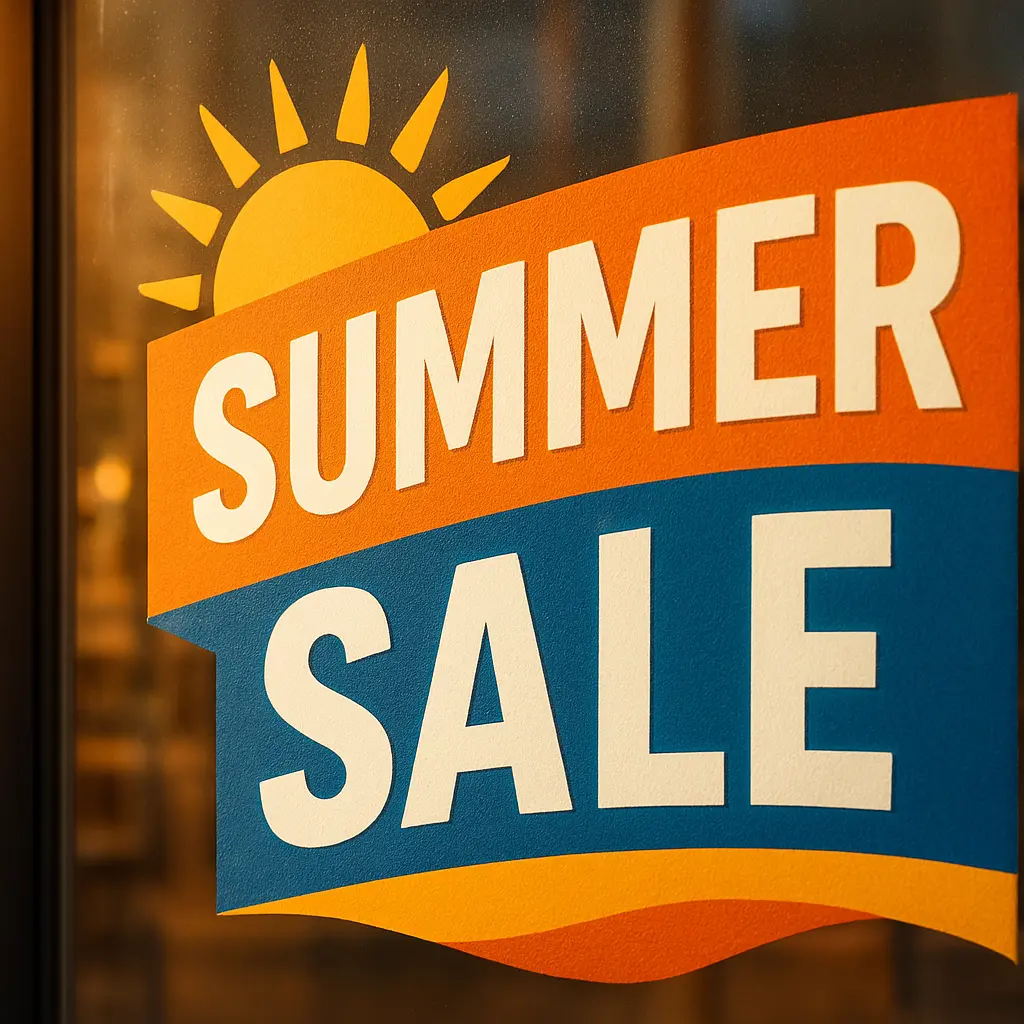
Vehicle Traffic Considerations
Drivers process information differently than pedestrians. They’re moving faster and can’t read paragraph text. For locations on roads with 25+ mph speed limits, use 8-inch minimum lettering and limit text to 5-7 words total. “50% OFF SUMMER SALE” works. Anything longer gets ignored because they’ve driven past before processing it.
Angle matters for driver visibility. Windows perpendicular to traffic flow create glare issues during morning and evening sun angles. If possible, place promotional decals on windows that face 30-45 degrees toward oncoming traffic, which improves readability and reduces reflective interference.
Pro tip: Use reverse-cut vinyl (white text on clear background) for windows where you want customers to see into your store while still displaying sale messaging to street traffic.
Promotional Decals Versus Banners
| Feature | Vinyl Window Decals | Retractable Banners |
|---|---|---|
| Installation Time | 5-10 minutes, permanent until removal | 30 seconds setup, requires daily deployment/storage |
| Weather Resistance | Complete waterproof and UV protection, 6+ years outdoor lifespan | Fabric fades within 6-12 months of UV exposure, wind damage risk |
| Visibility Range | 50-75 feet effective range for pedestrians, limited for vehicle traffic | 15-30 feet effective range, portable positioning advantage |
| Message Flexibility | Requires removal and replacement for new messaging | Swap cassettes or entire banner in under 2 minutes |
| Cost Per Season | $45-150 one-time cost for 60-90 day campaign | $85-200 for banner plus $120-180 for stand, reusable with new prints |
| Professional Appearance | High-end, integrated with storefront architecture | Can appear temporary or discount-focused depending on design quality |
In practice, the most effective approach combines both. Vinyl window decals handle the permanent street-facing advertising with maximum weather durability, while retractable banners provide flexible sidewalk positioning that you can adjust hourly based on sun angles, foot traffic patterns, and which entrance customers are using.
Banners excel at last-minute messaging changes. If inventory shifts during your summer sale and you need to pivot from “50% Off Dresses” to “Buy One Get One Shoes,” you can print and install a new banner in 24-48 hours. Changing vinyl decals requires removal, new production, and reinstallation, typically 7-10 days minimum.
Seasonal Marketing Timing and Removal
The biggest tactical error is installing summer sale signage after the season starts. Customers make purchasing decisions 1-2 weeks before events. Memorial Day weekend shoppers are already in buying mode by mid-May. Your promotional decals need to be visible by May 15th to capture early planners who generate 35-40% of seasonal revenue.
Production timelines demand backward planning. Custom vinyl decals require 3-5 business days for production after design approval, plus 3-7 days shipping depending on location. Add 2-3 days for design revisions. You need to finalize your order by May 1st for May 15th installation. Late orders force expensive rush fees or generic stock designs that underperform.
Removal Strategy and Surface Protection
ORACAL® 651 vinyl removes cleanly when you use proper technique. Heat the decal with a standard hair dryer on high setting for 30-45 seconds, which softens the adhesive. Peel slowly at a 45-degree angle, starting from one corner. If adhesive residue remains, remove it with isopropyl alcohol and a microfiber cloth, never scrapers or abrasive cleaners that scratch glass.
Timing removal correctly matters for brand perception. Leaving “SUMMER SALE” decals up through September signals disorganization and diminishes credibility for fall promotions. Remove seasonal signage within 3-5 days of campaign end dates. The effort takes 15 minutes but prevents weeks of mixed messaging confusion.
Archived vinyl decals can be reused if stored properly. After removal, place decals on release liner sheets or wax paper, roll loosely, and store in cool, dry locations away from direct sunlight. Properly stored vinyl maintains adhesive properties for 12-18 months, allowing you to reuse successful summer sale designs in subsequent years.
Multi-Season Planning
Smart retailers order vinyl graphics in quarterly batches. Summer sale signage gets designed and produced in April, back-to-school messaging in June, fall/Halloween in August, and holiday promotions in October. This eliminates rush fees, allows bulk pricing negotiations, and ensures you’re never caught without current seasonal marketing materials.
Maintain a design library of successful sale signage from previous years. If a particular layout generated measurable foot traffic increases, you have proven creative assets ready for immediate reordering. Testing new designs every season wastes money when you already have conversion data showing what works for your specific customer base.
Frequently Asked Questions
How large should summer sale signage be for maximum impact?
Window decals should occupy 20-30% of available glass space to maximize visibility without completely blocking interior views. For standard 4×6 foot storefront windows, this translates to 36×48 inch vinyl graphics. Larger isn’t always better because completely covered windows prevent customers from seeing product displays and can make stores feel closed or uninviting. The goal is attention-grabbing presence while maintaining visual access to your merchandise.
Can vinyl decals be applied to textured or tinted glass?
ORACAL® 651 vinyl adheres successfully to lightly textured glass but struggles with heavily frosted or deeply etched surfaces where adhesive contact is inconsistent. Tinted windows work fine as long as the surface is smooth and clean. The limitation is visual contrast, dark tinted glass requires white or bright yellow vinyl to maintain readability. Test adhesion on a small corner section before committing to full installation on non-standard glass surfaces.
What discount percentage generates the highest response for summer sales?
Consumer psychology research consistently shows 40-50% discounts generate peak response rates. Discounts below 30% fail to create sufficient urgency to modify shopping behavior, people wait for better deals. Discounts above 60% trigger skepticism about product quality or original pricing legitimacy. The sweet spot is 40-50% off, which balances perceived value with credibility. If your actual margins only support 25% discounts, focus messaging on dollar savings rather than percentages.
How do you prevent vinyl decals from creating interior glare?
Specify matte or satin finish vinyl instead of glossy when ordering. Matte finishes diffuse light and eliminate the reflective hot spots that create readability problems. For windows receiving direct afternoon sun, consider perforated window vinyl that allows 40-50% light transmission while maintaining exterior graphic visibility. This reduces heat buildup and glare while preserving your sale messaging impact.
What information must be included on promotional decals for legal compliance?
Most jurisdictions require clear disclosure of sale end dates, any purchase restrictions, and whether discounts apply to all items or select merchandise only. The phrase “up to” before discount percentages is legally significant because it permits variable discounting across product categories. Include fine print stating “see store for details” and ensure in-store signage provides complete terms. Misleading sale signage creates liability exposure and damages customer trust more severely than conservative discount claims.
How far in advance should seasonal vinyl graphics be ordered?
Order custom vinyl decals 3-4 weeks before your campaign launch date to account for design approval cycles, production time, shipping variables, and installation scheduling. Rush production is available but adds 30-50% cost premiums and limits customization options. Retailers running multiple seasonal campaigns annually should establish design templates in January that require only text updates, reducing reorder turnaround to 7-10 days for subsequent seasons.
Do vinyl decals damage painted surfaces when removed?
Professional-grade removable vinyl like ORACAL® 651 is engineered for clean removal from painted surfaces when applied and removed correctly. The risk occurs when decals remain in place for 3+ years in extreme UV exposure, which can cause adhesive bonding that removes paint during removal. For painted wood, metal, or drywall applications lasting longer than 18 months, use low-tack specialty vinyl designed for extended temporary applications. Always test on an inconspicuous area first.
What seasonal marketing strategies have worked best for your retail location, and how do you measure the effectiveness of different sale signage approaches?