
Most small businesses lose potential customers before they even reach the door, and the problem is almost always visible from the sidewalk. Poor or incomplete storefront signage doesn’t just make a business look unprofessional. It actively prevents foot traffic by failing to communicate basic information like operating hours, services offered, or whether you’re even open. According to the Small Business Administration, effective signage can increase overall revenue by up to 10%, yet many retailers still treat it as an afterthought. If your storefront signs aren’t working hard to convert passersby into customers, you’re leaving money on the table.
Table of Contents
- Quick Takeaways
- Open Hours Decals
- Window Graphics and Branding
- Directional and Wayfinding Signs
- Promotional Sidewalk Signs
- Illuminated Storefront Signage
- Choosing the Right Materials for Durability
- Frequently Asked Questions
- References
Quick Takeaways
| Key Insight | Explanation |
|---|---|
| Hours decals prevent lost sales | Customers won’t guess your hours. Clear open hours decals reduce confusion and abandoned visits by up to 30%. |
| Window graphics build brand recognition | Consistent visual branding on windows increases recall and differentiates you from competitors within 50 feet. |
| Directional signs improve customer experience | Wayfinding signage reduces customer frustration and increases dwell time, especially for multi-entrance or complex layouts. |
| Sidewalk signs drive immediate action | A-frame and sandwich boards highlighting daily specials or promotions can increase walk-in traffic by 20% or more. |
| Illuminated signs extend business hours visibility | Lit signage makes your business visible during evening hours, capturing customers who shop after standard business hours. |
| Professional-grade vinyl outlasts cheap alternatives | ORACAL 651 vinyl withstands UV exposure and weather for 6+ years outdoors, while bargain vinyl fades in 12-18 months. |
| Compliance signage protects your business | ADA-compliant and code-required signs aren’t optional. Missing them exposes you to fines and accessibility lawsuits. |
Open Hours Decals
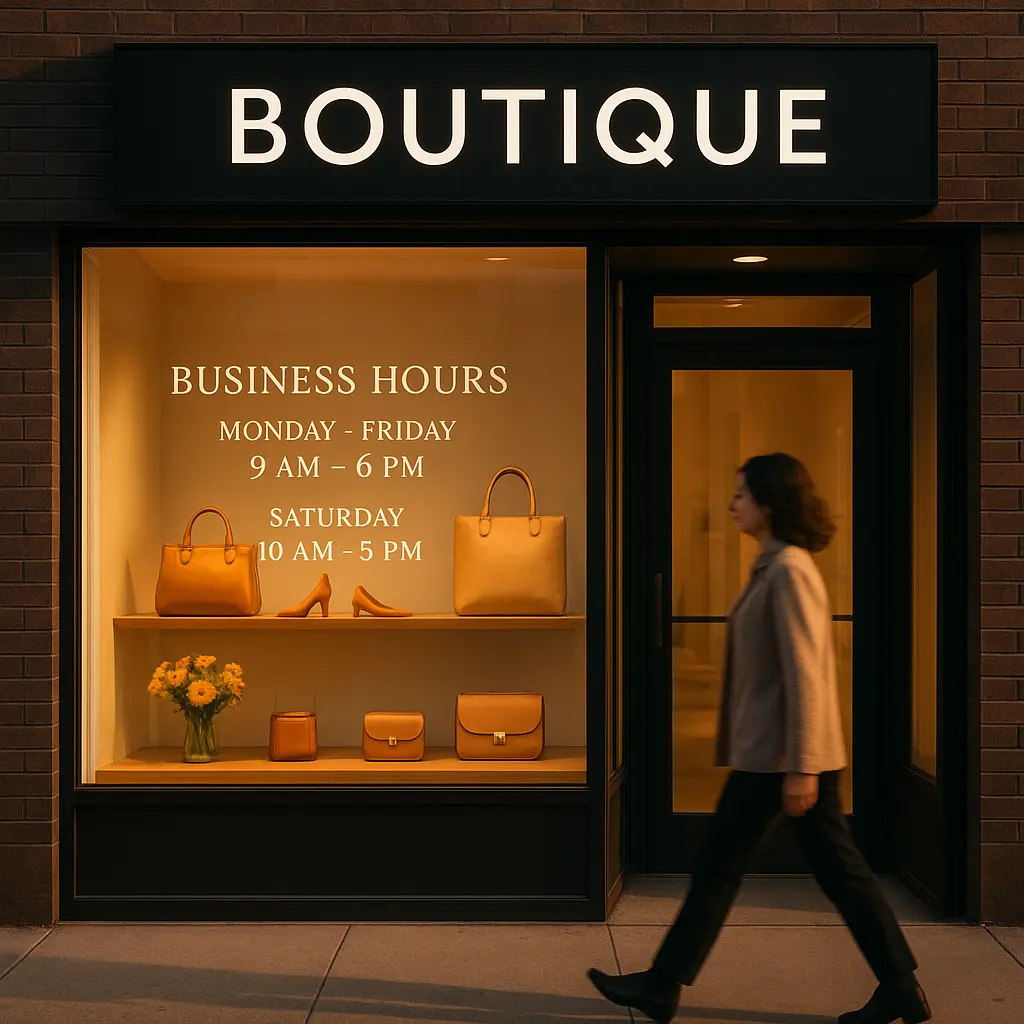
The single most frustrating customer experience is arriving at a store only to find it unexpectedly closed. Open hours decals solve this problem by displaying your schedule directly on your door or window, visible 24/7. In practice, businesses that clearly post hours see fewer angry phone calls and negative reviews stemming from confusion about operating times.
The ideal placement is at eye level on your primary entrance door, readable from at least 10 feet away. Use professional-grade vinyl like ORACAL 651, which remains legible and intact through years of sun exposure, temperature fluctuations, and regular cleaning. Cheap decals fade to illegibility within months, creating the exact problem you’re trying to solve.
Pro tip: Include both regular hours and special holiday hours on separate lines. Many businesses update a paper sign taped inside the window for holidays, which looks unprofessional and temporary.
What Information to Include
Beyond basic daily hours, specify whether you’re open by appointment, if lunch closures apply, or if hours vary seasonally. Ambiguity costs you customers. A decal that reads “Monday to Friday 9-5” is less helpful than “Mon-Fri 9am-5pm, Sat 10am-3pm, Sun Closed.” The difference is specificity.
Some retailers also add “Last customer accepted 15 minutes before closing” to manage expectations. This prevents the scenario where someone walks in at 4:58pm expecting full service when you close at 5pm.
Window Graphics and Branding
Your storefront windows are premium advertising space you already own, yet most small businesses leave them blank or cluttered with outdated posters. Strategic window graphics communicate your brand identity, services offered, and unique value proposition to everyone who walks past.
Effective window branding includes your business name, logo, tagline, and key service categories. A coffee shop might display “Fresh Roasted Daily, Espresso, Pastries, Free WiFi” in clean vinyl lettering. A salon could list “Cuts, Color, Extensions, Walk-ins Welcome.” These aren’t decorative. They’re functional signage that answers the question “What does this business do?”
Perforated vs. Solid Vinyl
Perforated window film allows you to see out while presenting solid graphics to passersby, ideal for maintaining natural light and visibility inside your store. Solid vinyl works better for accent graphics, borders, and text where complete coverage isn’t necessary. The data consistently shows that businesses using perforated film for large-coverage branding maintain better interior ambiance while maximizing exterior impact.
A common mistake is covering more than 40% of window surface area with solid graphics. This creates a closed-off feeling that discourages entry. Keep coverage under 30% unless you’re deliberately creating privacy for service areas.
“Retailers with cohesive visual branding across all touchpoints, including window signage, experience 23% higher customer recognition compared to those with inconsistent branding.” – According to retail branding studies documented by the Sign Research Foundation.
Directional and Wayfinding Signs
If your business has multiple entrances, parking in the rear, or services located in different areas, directional signage becomes essential infrastructure. Customers who can’t figure out where to park or which door to use often leave rather than risk embarrassment or wasted time.
Wayfinding signs should be placed at decision points: parking lot entrances, building corners where customers might turn the wrong way, and lobbies or waiting areas where services split. Use arrows, simple language, and high contrast. “Main Entrance →” or “Parking in Rear” need no interpretation.
Interior Wayfinding for Multi-Service Businesses
Medical offices, salons with multiple service areas, and retail stores with specialty departments need interior directional signs. Vinyl lettering applied to walls or doors works well for permanent designations. Retractable banners offer flexibility for temporary promotions or seasonal department changes.
The goal is reducing the cognitive load on customers. Every second they spend confused about where to go is a second they’re not engaging with your products or services. Poor wayfinding creates stress, and stressed customers buy less.
Pro tip: Test your directional signage by asking first-time visitors to navigate without assistance. If they hesitate or ask for help, add signage at that exact decision point.
Promotional Sidewalk Signs
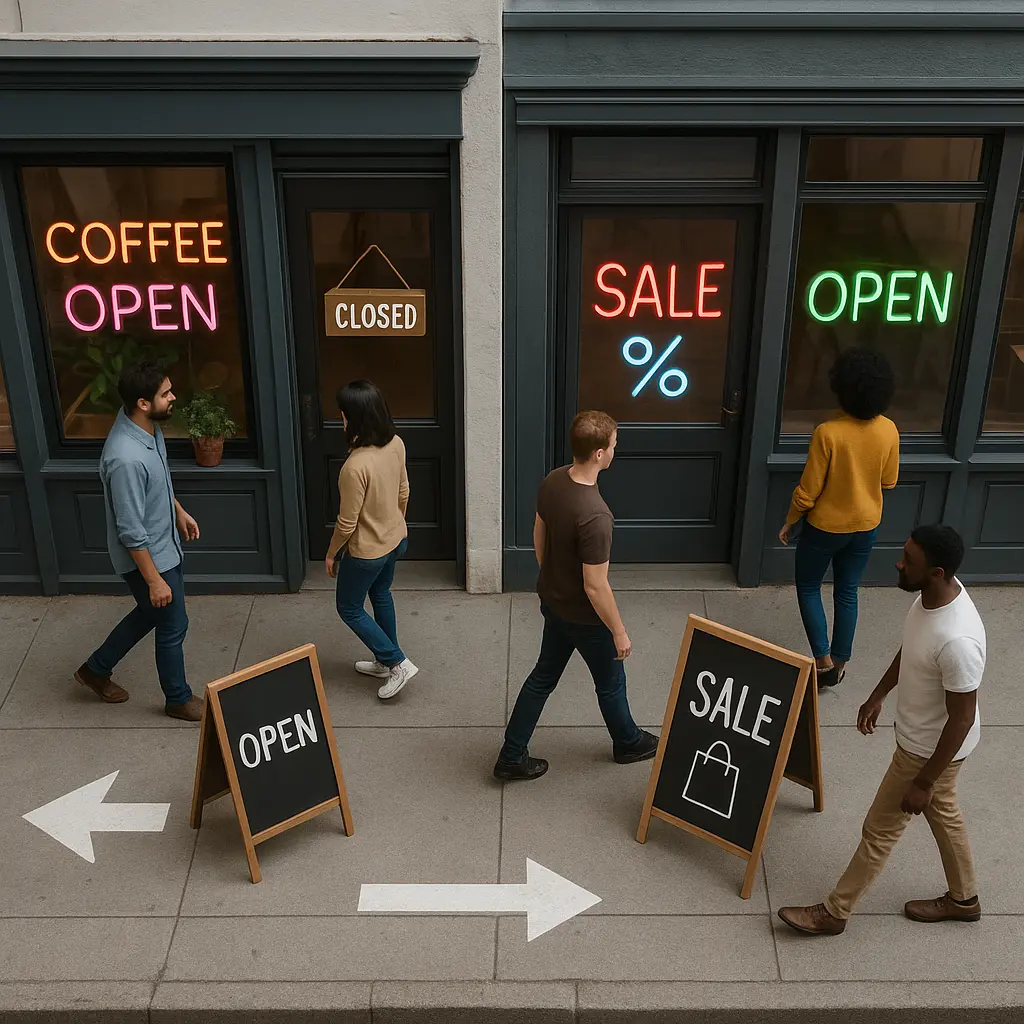
A-frame sidewalk signs, also called sandwich boards, remain one of the highest-ROI business signage investments available. They capture impulse traffic by promoting daily specials, limited-time offers, or simply announcing “Open Now” to passersby who might not otherwise notice your storefront.
The key to effective sidewalk signs is daily updates. A board displaying the same message for weeks becomes invisible through familiarity. Restaurants that change their board daily with specials or witty messages consistently outperform those with static signage. The fresh content creates a reason for regular passersby to actually read the sign.
Size and Placement Regulations
Most municipalities regulate sidewalk sign dimensions, placement distance from the curb, and hours they can be displayed. Common restrictions include maximum heights of 42-48 inches and requirements to maintain a clear pedestrian pathway of at least 36 inches. Verify local codes before purchasing to avoid fines or forced removal.
Weight matters for stability. Lightweight signs blow over in wind, creating both a safety hazard and a poor brand impression. Look for weighted bases or fill hollow frames with sand for stability in outdoor conditions.
Illuminated Storefront Signage
Businesses operating beyond daylight hours need illuminated signage to remain visible and appear open. A dark storefront signals closure, even if your doors are unlocked and you’re actively serving customers inside. External lighting or internally lit channel letters ensure visibility during evening and early morning hours.
LED illumination has largely replaced neon and fluorescent options due to dramatically lower energy costs and longer lifespan. A typical LED-lit channel letter sign consumes 75% less electricity than equivalent neon while lasting 50,000+ hours versus 15,000 for neon tubes.
Backlit vs. Front-Lit Options
Backlit channel letters create a halo effect against the building facade, offering sophisticated visibility without glare. Front-lit letters provide maximum brightness and readability at distance. The choice depends on your building’s architecture and local light pollution restrictions.
Some commercial districts restrict illuminated signage hours or brightness levels to reduce light pollution. Check zoning codes before installation. In practice, most regulations permit business-hours lighting but may restrict late-night illumination in residential-adjacent zones.
Choosing the Right Materials for Durability
The material quality of your retail signage directly determines how long it maintains professional appearance. Cheap vinyl decals yellow and crack within 18 months of outdoor exposure. Professional-grade materials like ORACAL 651 vinyl remain vibrant and intact for 6+ years, making the higher upfront cost irrelevant when calculated per year of service.
| Material Type | Outdoor Lifespan | Best Use Case |
|---|---|---|
| ORACAL 651 Vinyl | 6+ years | Permanent window decals, vehicle graphics, exterior lettering requiring UV and weather resistance |
| Economy Calendered Vinyl | 12-18 months | Short-term promotions, temporary signage where replacement is planned and budget is constrained |
| Perforated Window Film | 3-5 years | Large window coverage where interior visibility outward is required while maintaining exterior graphics |
UV resistance and weatherproofing aren’t marketing terms, they’re measurable performance characteristics. ORACAL 651 includes UV inhibitors in the vinyl formulation and uses solvent-based adhesives that maintain bond strength through temperature cycling. Economy vinyl uses water-based adhesives that fail in heat and cold.
Installation Method Impact on Longevity
Even premium vinyl fails prematurely if applied incorrectly. Proper installation requires clean, dry surfaces, application at temperatures between 50-90°F, and complete removal of air bubbles that create moisture pockets. Professional installation eliminates these variables, which is why most commercial signage comes with installation included or strongly recommended.
A common mistake is attempting to save $50 on installation for a $200 decal, then watching it peel within six months due to improper surface preparation or bubble-induced adhesive failure. The labor cost is insurance against material waste.
Frequently Asked Questions
How long do outdoor vinyl decals typically last?
Professional-grade ORACAL 651 vinyl lasts 6+ years outdoors with full UV and weather exposure when properly installed. Economy vinyl typically shows significant fading and edge lifting within 12-18 months. The lifespan difference comes from UV inhibitors, adhesive quality, and vinyl thickness. Businesses should budget for replacement every 5-6 years for premium materials or annually for budget options.
What size should my open hours decal be for maximum visibility?
Open hours decals should be readable from at least 10 feet away, which typically requires lettering between 2-3 inches tall. For doors set back from the sidewalk or in low-traffic areas, increase to 3-4 inches. The rule is simple: if a customer has to approach within arm’s reach to read your hours, the decal is too small and you’ll lose impatient shoppers.
Can I install vinyl decals on textured glass or brick?
Standard vinyl adheres poorly to heavily textured surfaces because the adhesive can’t make full contact with the substrate. Smooth glass, painted metal, and sealed wood work best. For brick or stucco, consider MDO signboard panels mounted to the wall rather than direct vinyl application. Some specialty cast vinyls conform to light texture, but performance degrades significantly compared to smooth surface application.
Do I need permits for sidewalk A-frame signs?
Most municipalities require permits or business licenses that specifically authorize sidewalk signage placement. Regulations typically cover size limits, placement distance from curbs, pedestrian clearance requirements, and display hours. Fines for non-compliance range from $50-500 depending on jurisdiction. Check with your city’s business licensing or public works department before placing any signage in public right-of-way areas.
What’s the difference between retractable banners and fixed window graphics?
Retractable banners offer portability and message flexibility, ideal for rotating promotions, trade shows, or seasonal campaigns. Window graphics provide permanent branding and informational signage with superior weather resistance. Use retractable banners for changeable content that needs frequent updates. Use vinyl window graphics for consistent brand elements, hours, services, and contact information that remain constant.
How do I maintain vinyl storefront signs to maximize their lifespan?
Clean vinyl signs with mild soap and water using a soft cloth, avoiding abrasive cleaners or rough scrubbing that scratches the surface. Never use ammonia-based glass cleaners directly on vinyl as they break down adhesive over time. Inspect edges quarterly and press down any lifting corners before moisture penetrates. Proper maintenance extends lifespan by 20-30% compared to neglected signage.
Should I match my storefront signage to my vehicle graphics?
Absolutely. Consistent visual branding across all customer touchpoints, including storefront signs, vehicle wraps, and marketing materials, increases brand recognition by 23% according to Sign Research Foundation data. Use identical fonts, color schemes, and logo treatments. When a customer sees your delivery vehicle and later encounters your storefront, the visual consistency builds familiarity and trust faster than disparate designs.
What signage has made the biggest difference for your storefront visibility, and what would you add or change if you were starting fresh today?